Free poker HUD · Windows and Mac · 9 sites

A free HUD with 36 stats
on every opponent.

After each hand, Flopnado reads the hand history file and updates the HUD on up to 4 tables at once. No live card data and no advice. Just who your opponents are, in numbers. The HUD and analytics are free forever. The calculators and GTO solver are there when you want to go deeper.

48-hour trial of everything · HUD and analytics free forever after · no card required

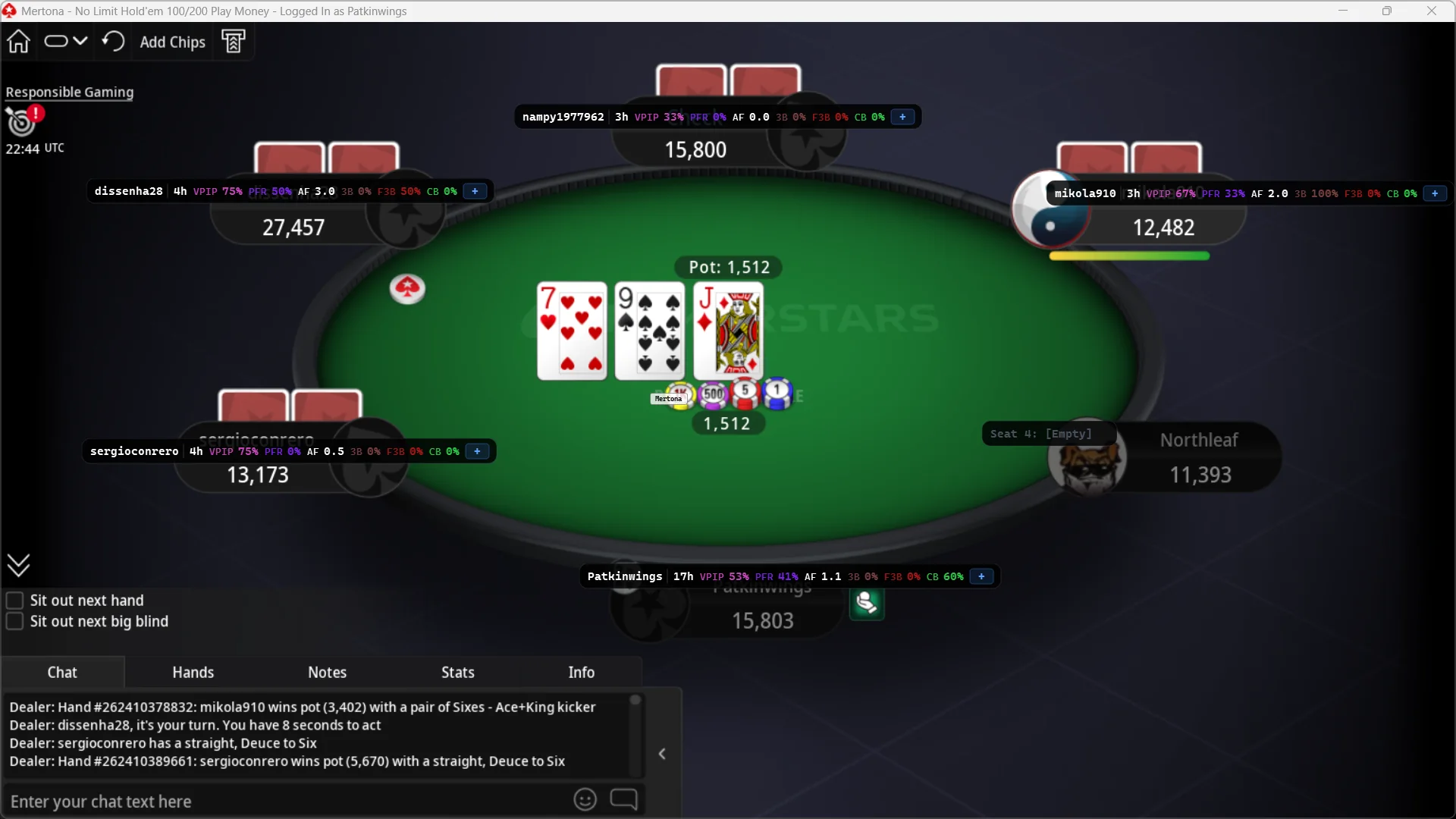
Flopnado HUD on a 6-max PokerStars table, one stat line above each player

On the tablefree forever

One line per opponent.

Each player gets a line on the table. It shows their name, how many hands you have on them, then VPIP, PFR, aggression, 3-bet, fold to 3-bet and c-bet. The numbers update after every hand. Click + to open the full popup.

Stats popup · 1 of 4free forever

Every stat on one player.

The popup puts their preflop, postflop and general stats in one box. Steals, 4-bets, fold to steal, blind defence, c-bets, donk bets, floats, check-raises, went to showdown and more. What each stat means

Stats popup · 2 of 4free forever

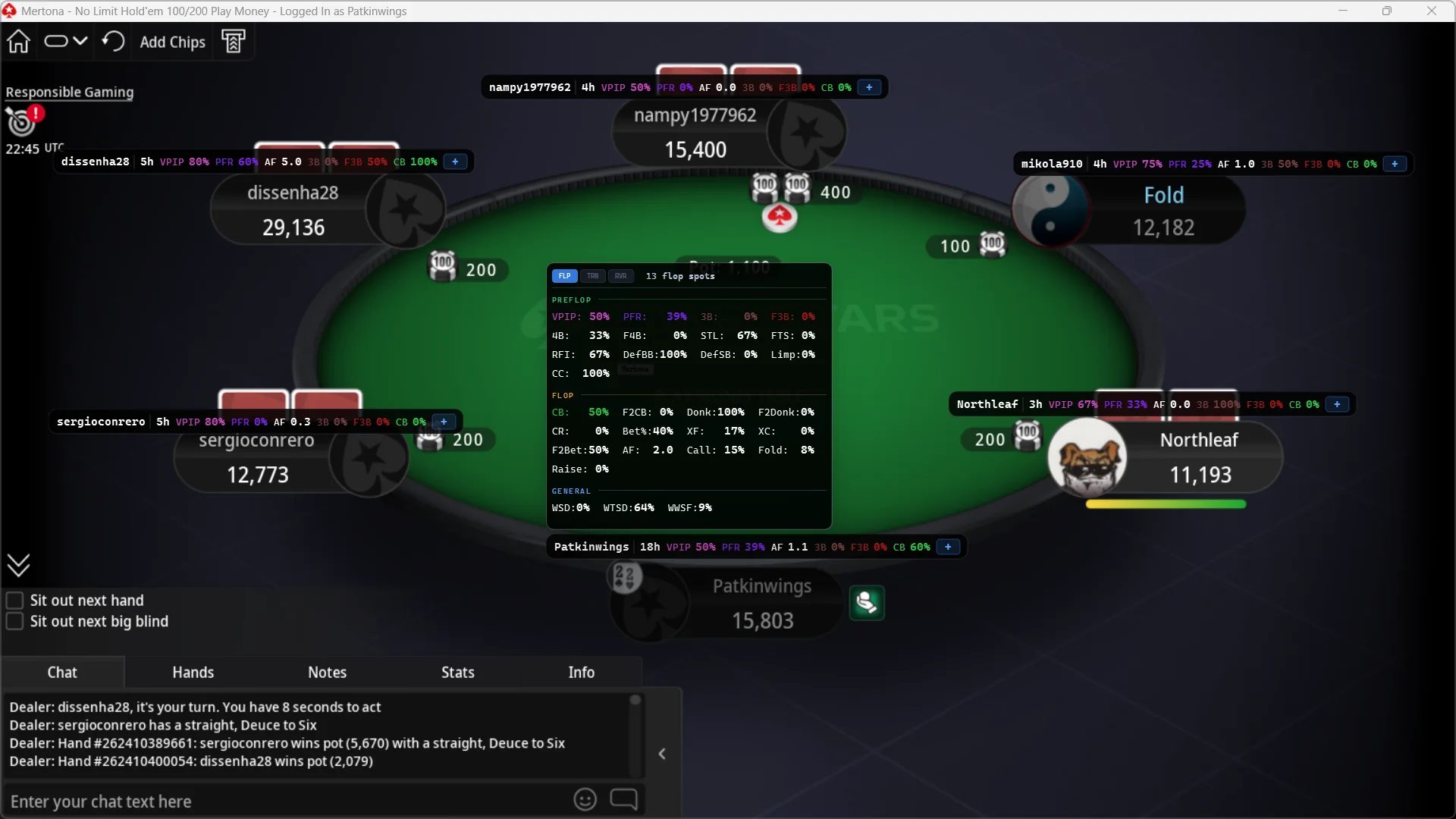
Postflop stats, one street at a time.

Press FLP and the postflop stats come from flop spots only. The counter shows how many spots they are based on, here 13, so you know how much to trust them.

Stats popup · 3 of 4free forever

Then the turn.

Press TRN for the same stats on the turn. This player c-bets the turn 67% of the time over 13 turn spots.

Stats popup · 4 of 4free forever

And the river.

RVR shows the river, here from 7 river spots. WTSD, WWSF and WSD stay in General, because they cover the whole hand.

Four tablesfree forever

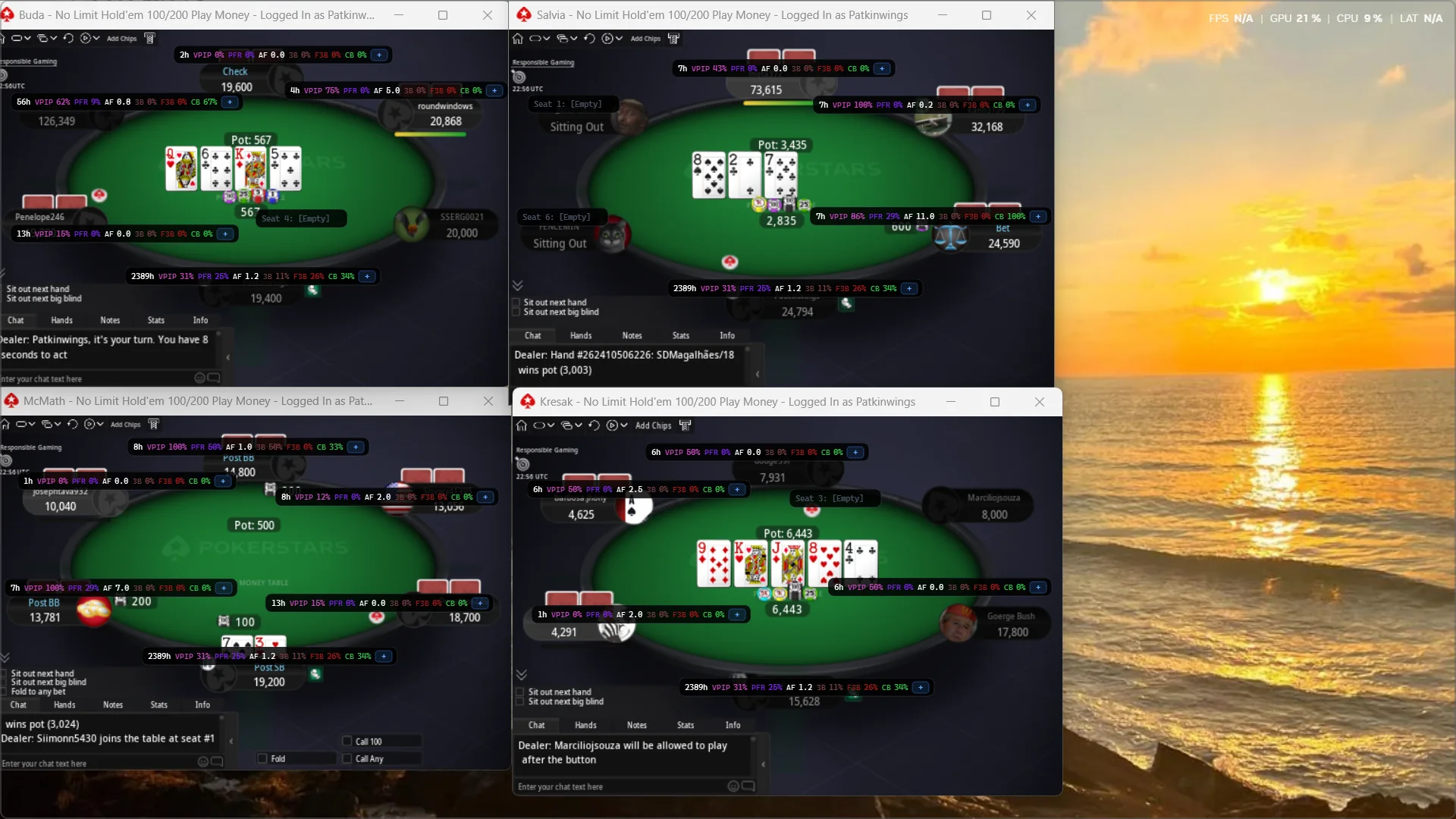
Up to four tables at once.

The HUD runs on up to 4 tables at the same time. Each table gets its own lines and popups.

Make it yours · 1 of 2free forever

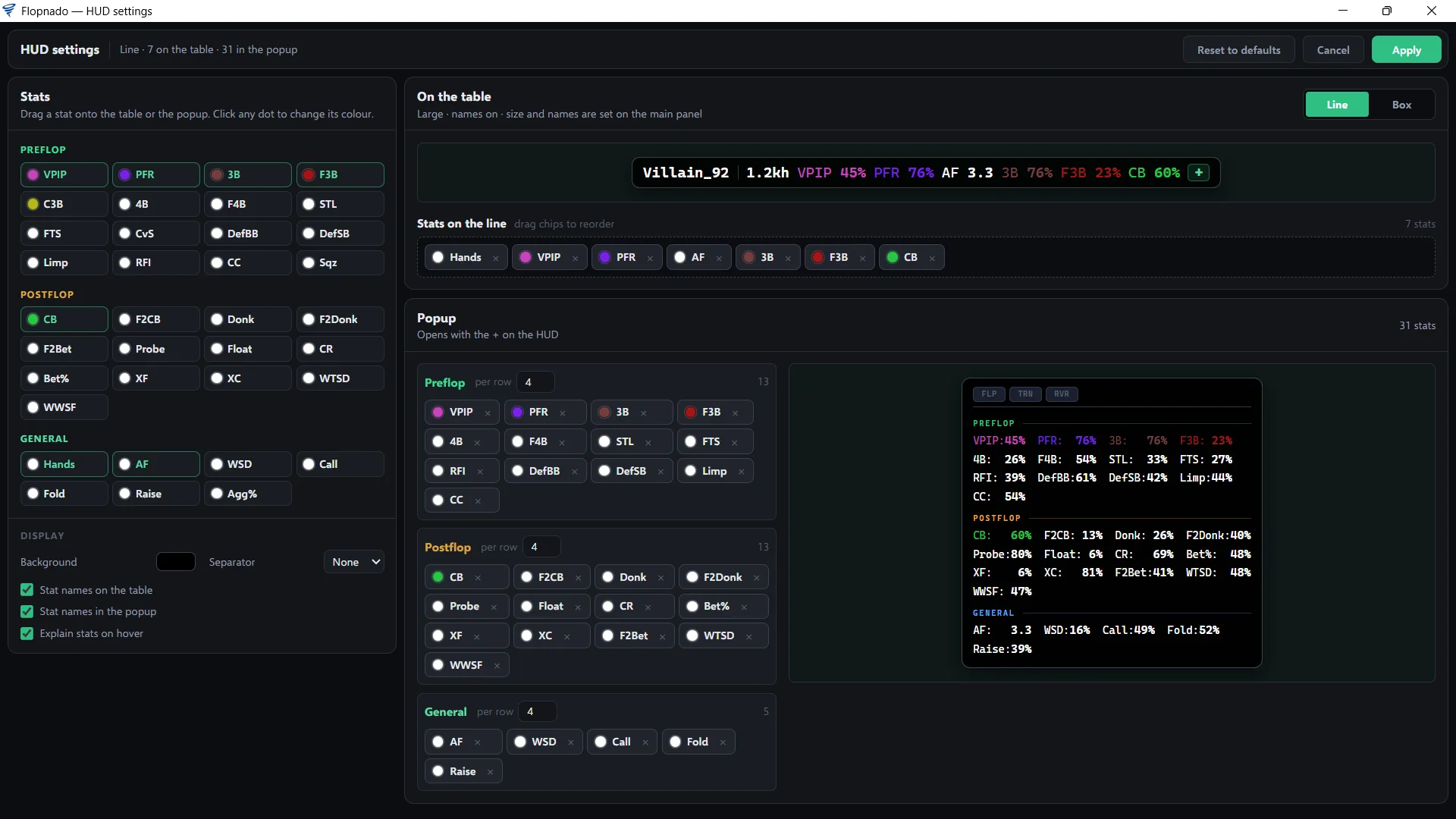
Pick your stats and colours.

Drag any stat onto the line or into the popup, and drag the chips to change the order. Click a dot to change a stat's colour. The preview shows how it will look on the table.

Make it yours · 2 of 2free forever

Line or box.

Switch to Box and add as many rows as you like. You also choose how many stats go on each row of the popup, the background colour, and whether stat names show.

Analyticsfree forever

Your own game, in numbers.

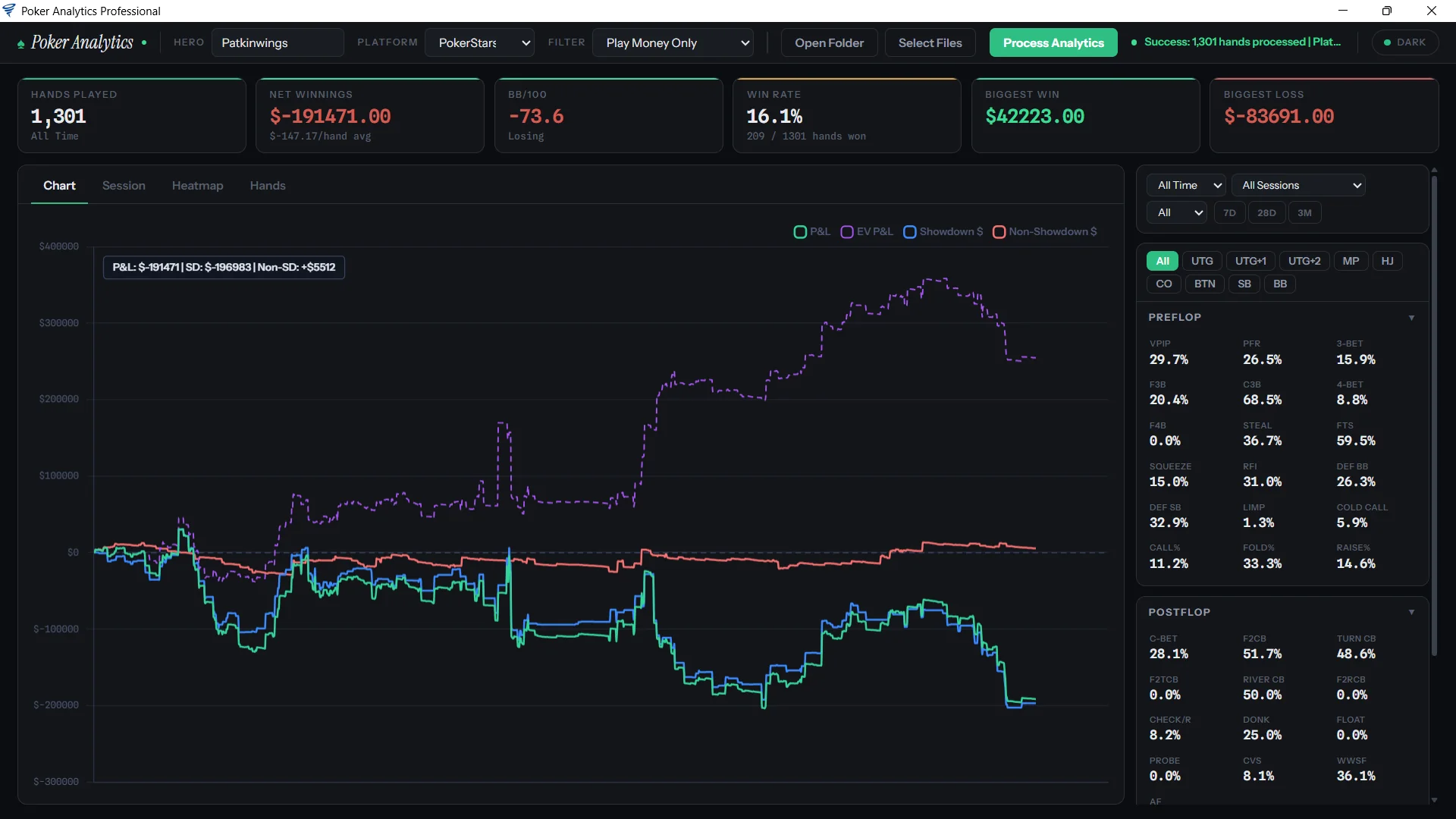
The same hands that feed the HUD feed your analytics. Your P&L against EV P&L shows whether a bad run is luck or a leak. You also get every session as a bar, profit for each starting hand on a 13×13 heatmap, and a replayer with your equity, pot odds and EV at every decision.

1 / 9

Free forever on up to 4 tables, no card needed. What each stat means · On a Mac? Every Mac HUD compared →

Three ways to read a player.

The HUD tracks 36 stats, like VPIP, PFR, 3-bet and c-bet, on every player you've sat with. You can view them three ways. What each stat means

Overallfree forever

Everything they've done.

Every hand you have on that player, from every seat, added up. This is the normal HUD view.

By positionpaid licence

How they play from the seat they're in now.

Most players play very differently from early position than from the button. Overall stats mix all of that together.

By position shows only the hands they played from the seat they're sitting in right now. When they move round the table, the numbers change with them.

Vs Hero · reverse HUDpaid licence

How you look to them.

Vs Hero turns the HUD round. Next to each opponent, it shows your own stats, counted only from hands where that player was at the table with you.

It's roughly what their HUD would be showing about you. If you've been folding to 3-bets a lot against one regular, you'll see it, and so might they.

By position and Vs Hero are included in the 48-hour trial. After that, they come with the €20 licence.

The calculators

When you want to go deeper.

From raw equity to a postflop GTO solver, for study between sessions. Step through the screens to see what each tool shows you.

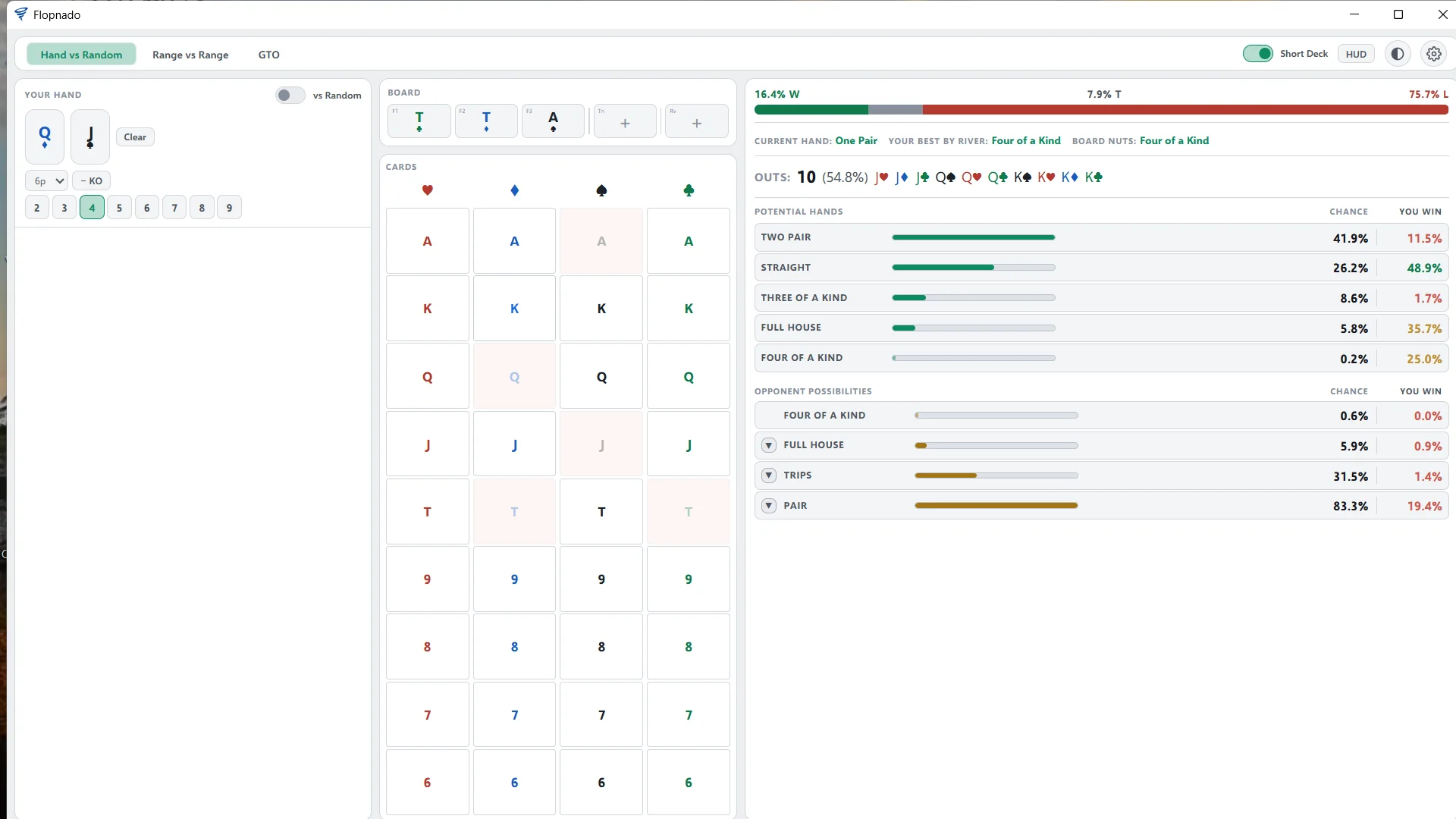
Hand vs Random: J♦T♠ on 7♥8♠K♦ against three opponents, with outs and potential hands

Hand vs Randomlocks during play

Your hand against the table.

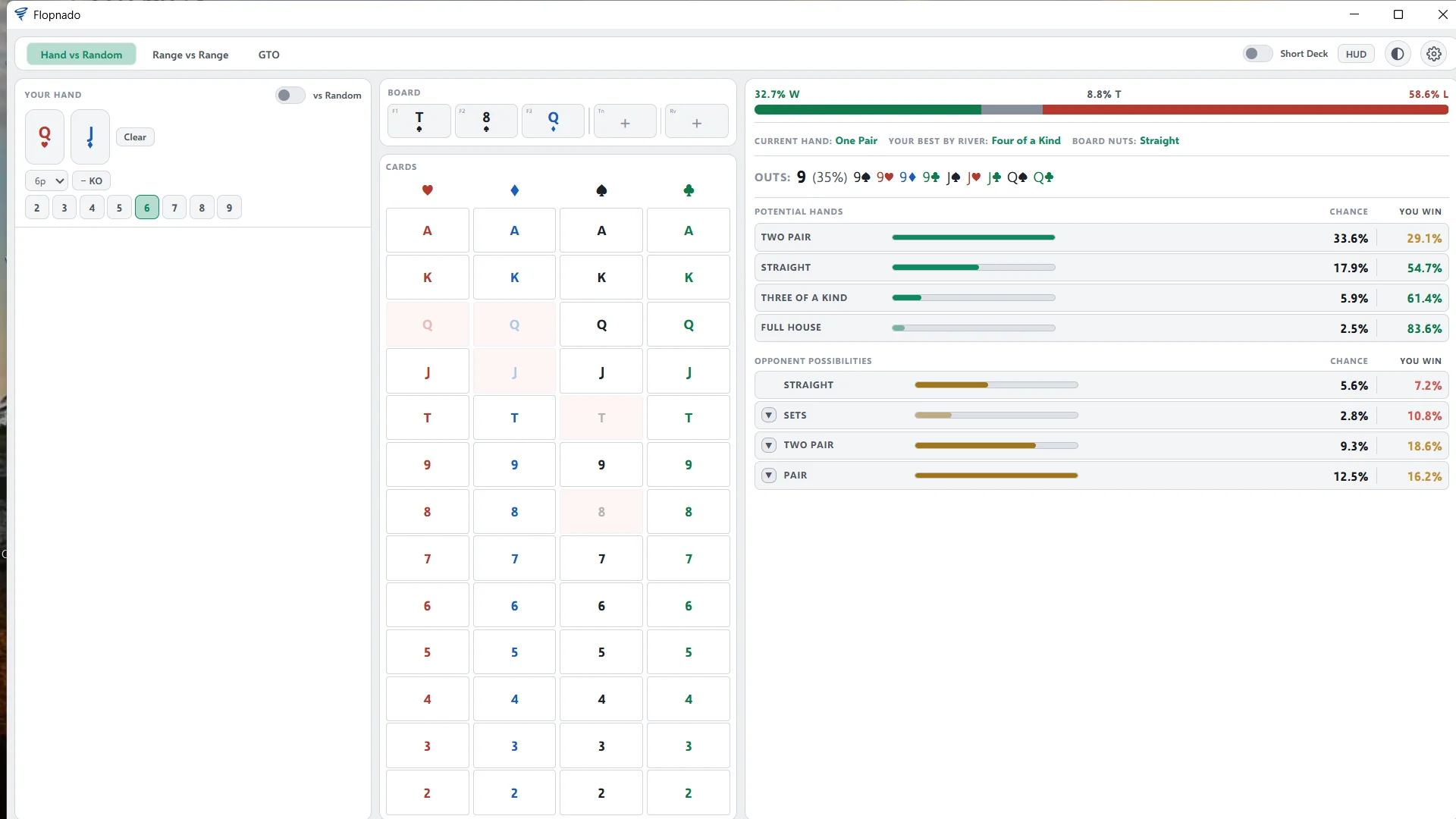
Enter your two cards and the board, and pick 2 to 9 players. You get win, tie and loss, every out card by card, your chance of making each hand by the river and how often it wins, and what your opponents might be holding. As players fold, the KO button takes them out.

Hand vs Rangelocks during play

Against a real range, not a random hand.

Flip the switch to vs Range. Pick 6-max or 9-max, how many players and a saved range, then your seat. It tells you if your hand is in that seat's range, and works out your equity against what the other players actually play.

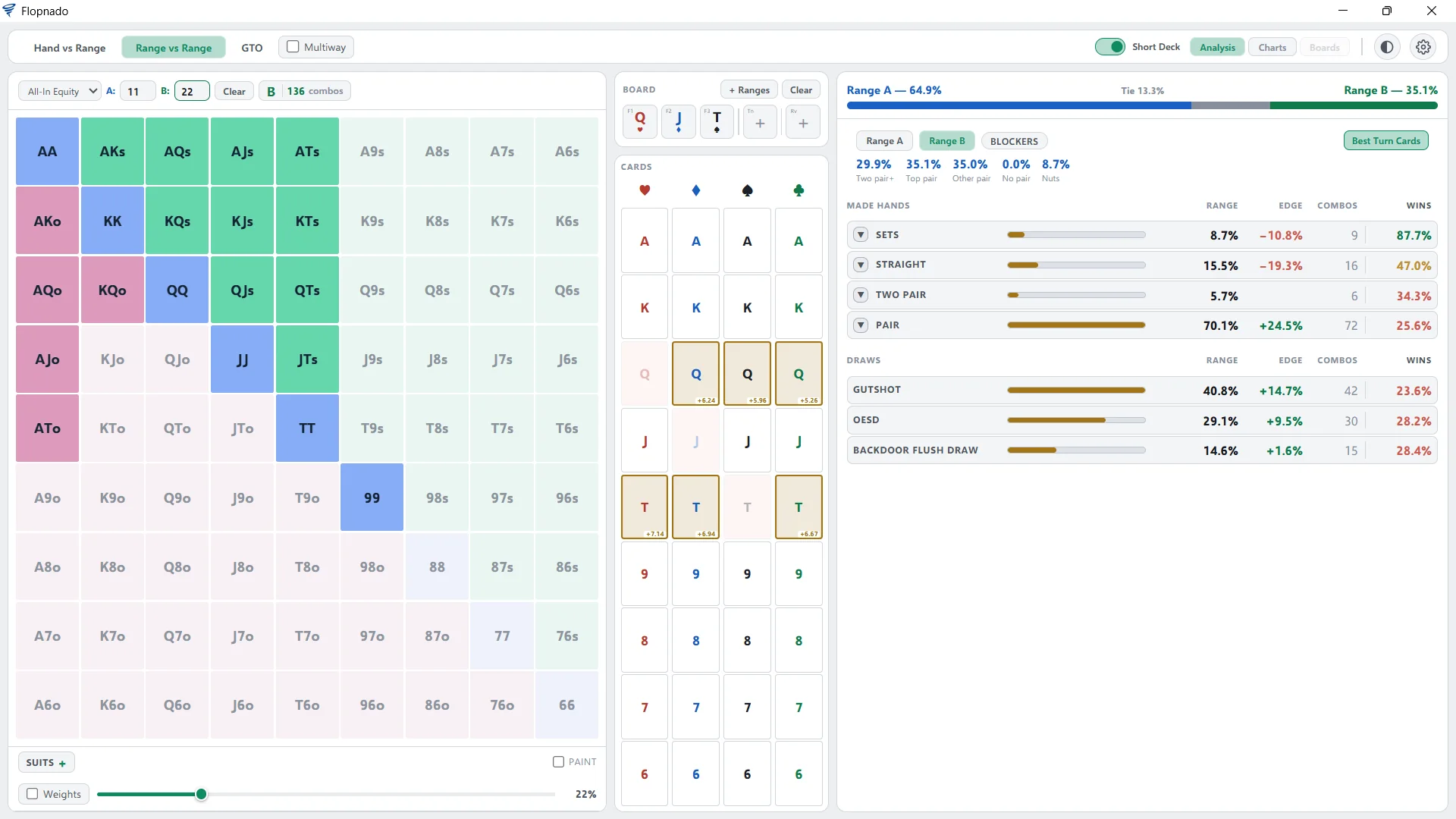
Range vs Range · 1 of 5locks during play

Two ranges, one board.

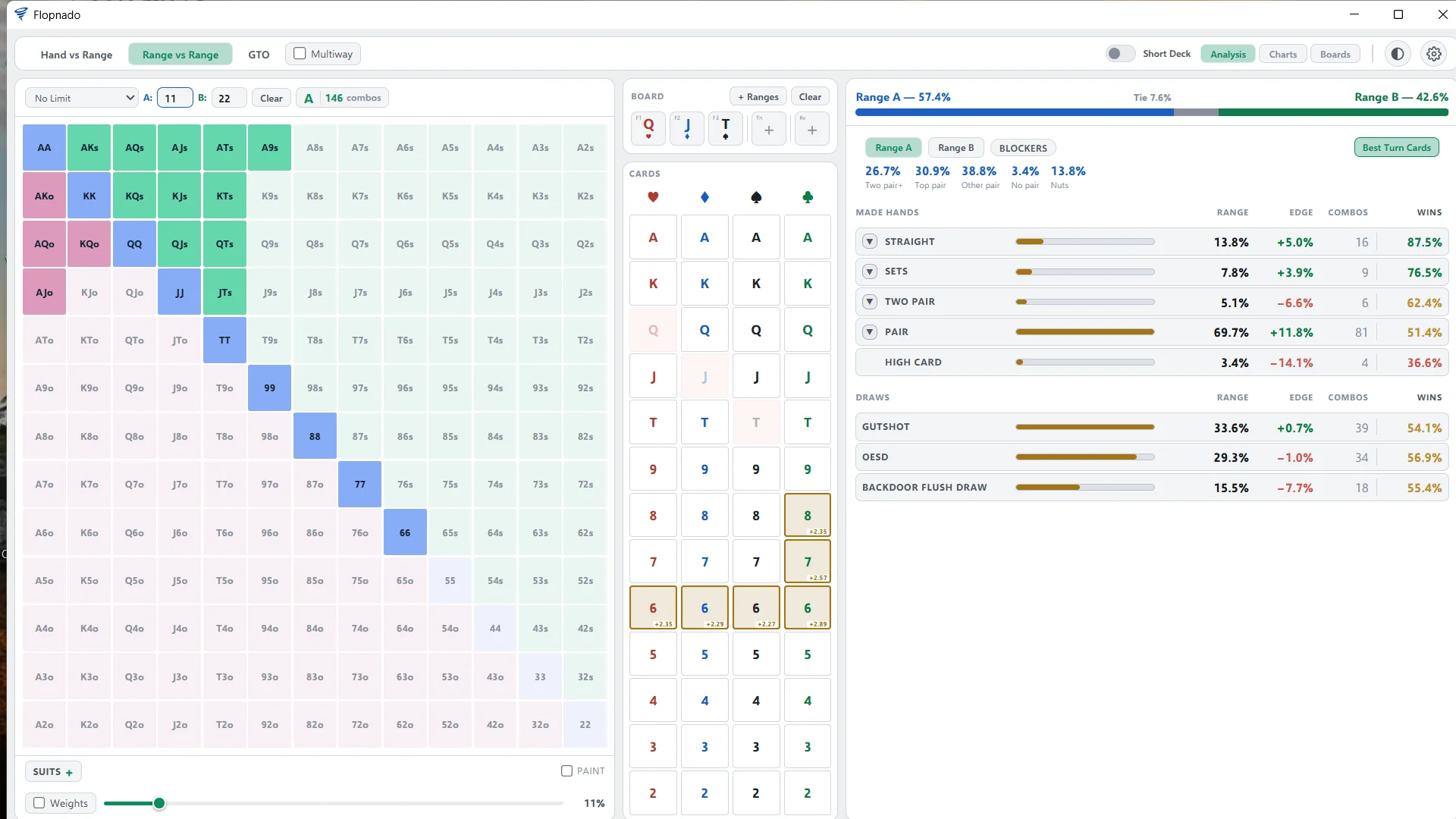
Build both ranges on the 13×13 grid: by top %, hand by hand, with weights and suit filters. You get each side's equity, then every made hand and draw with its share of the range, its edge over the other range, the combo count and how often it wins.

Range vs Range · 2 of 5locks during play

Click a category, see the hands.

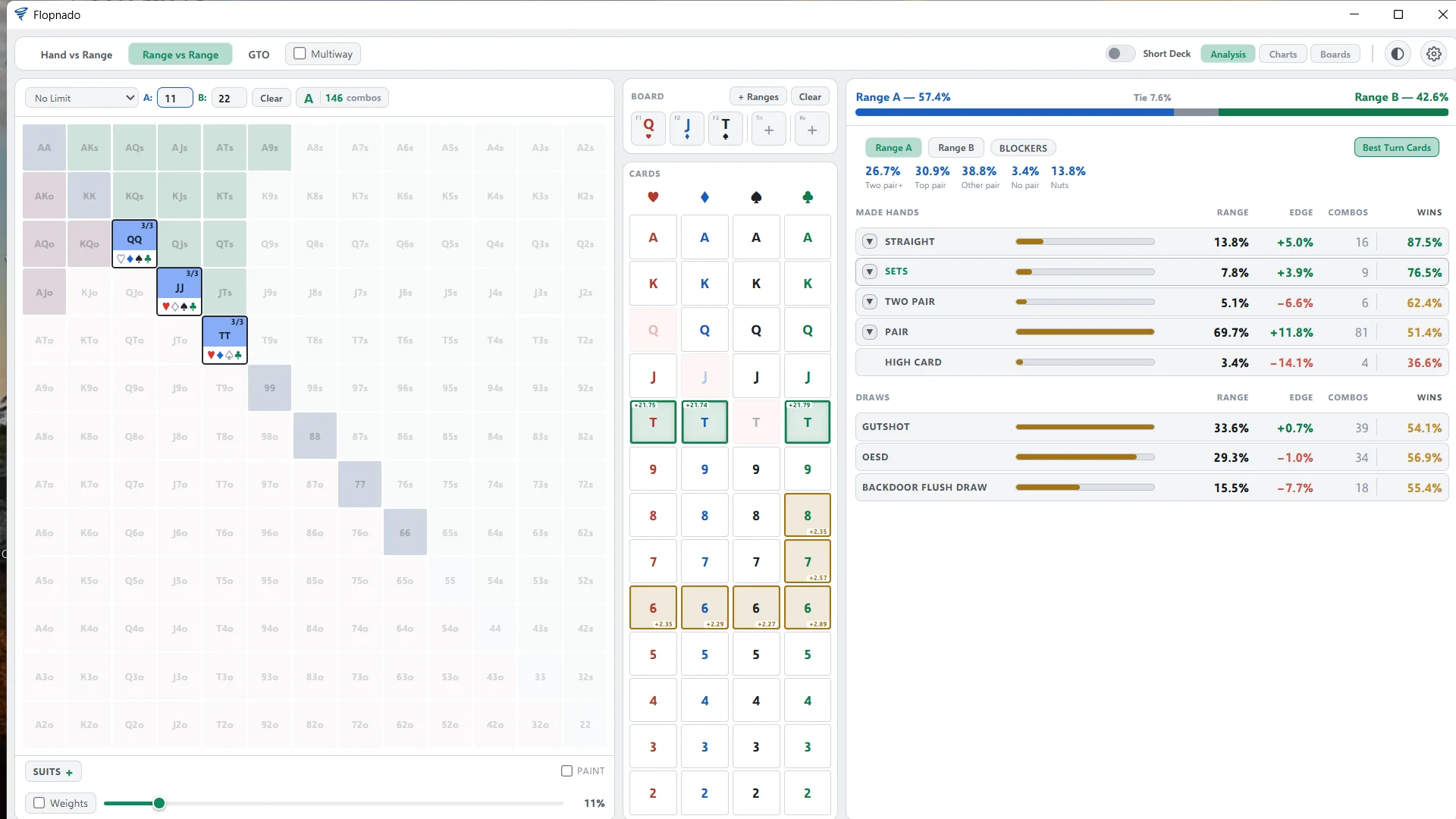
Click Two Pair and the grid shows exactly which hands make it, down to the suits. Each cell says how many of its combos count, like 7/7 or 2/2. The bar at the top shows that part of the range on its own: 55.8%.

Range vs Range · 3 of 5locks during play

Put one part against another.

Lock a category on each side. Range A's straights against Range B's two pair comes out 81.6% to 18.4%.

Range vs Range · 4 of 5locks during play

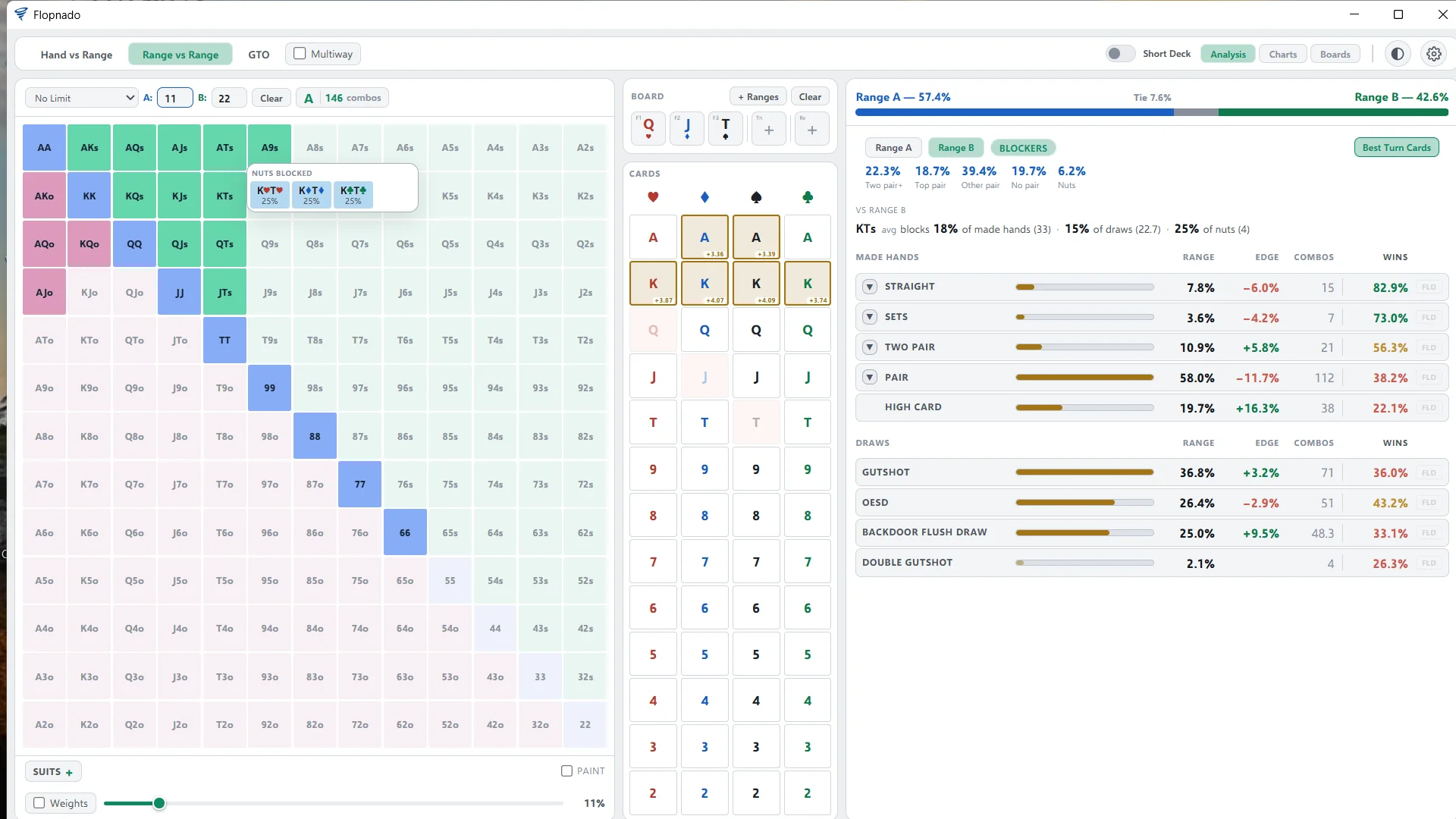
Which turn cards help you.

Best Turn Cards marks every turn that improves the range, with its equity gain. Here the sixes and two sevens help Range A by about 2 to 3 points.

Range vs Range · 5 of 5locks during play

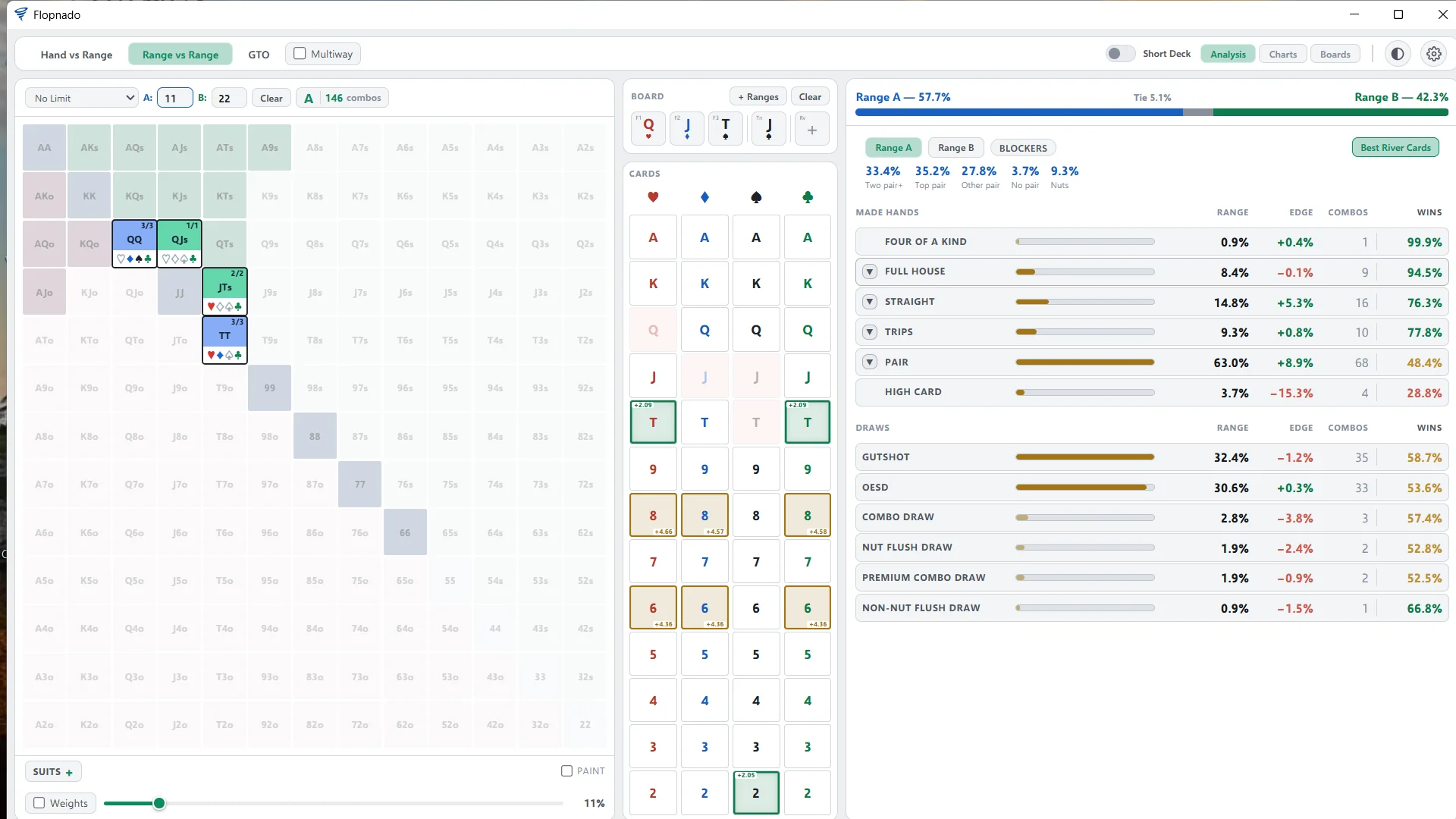
Best river cards, in dark mode.

Once the turn is out, the button becomes Best River Cards. Any king adds 4 to 5 points for Range B. The draws list grows too, with combo draws and nut and non-nut flush draws. Every screen also has a dark mode.

Charts · 1 of 4locks during play

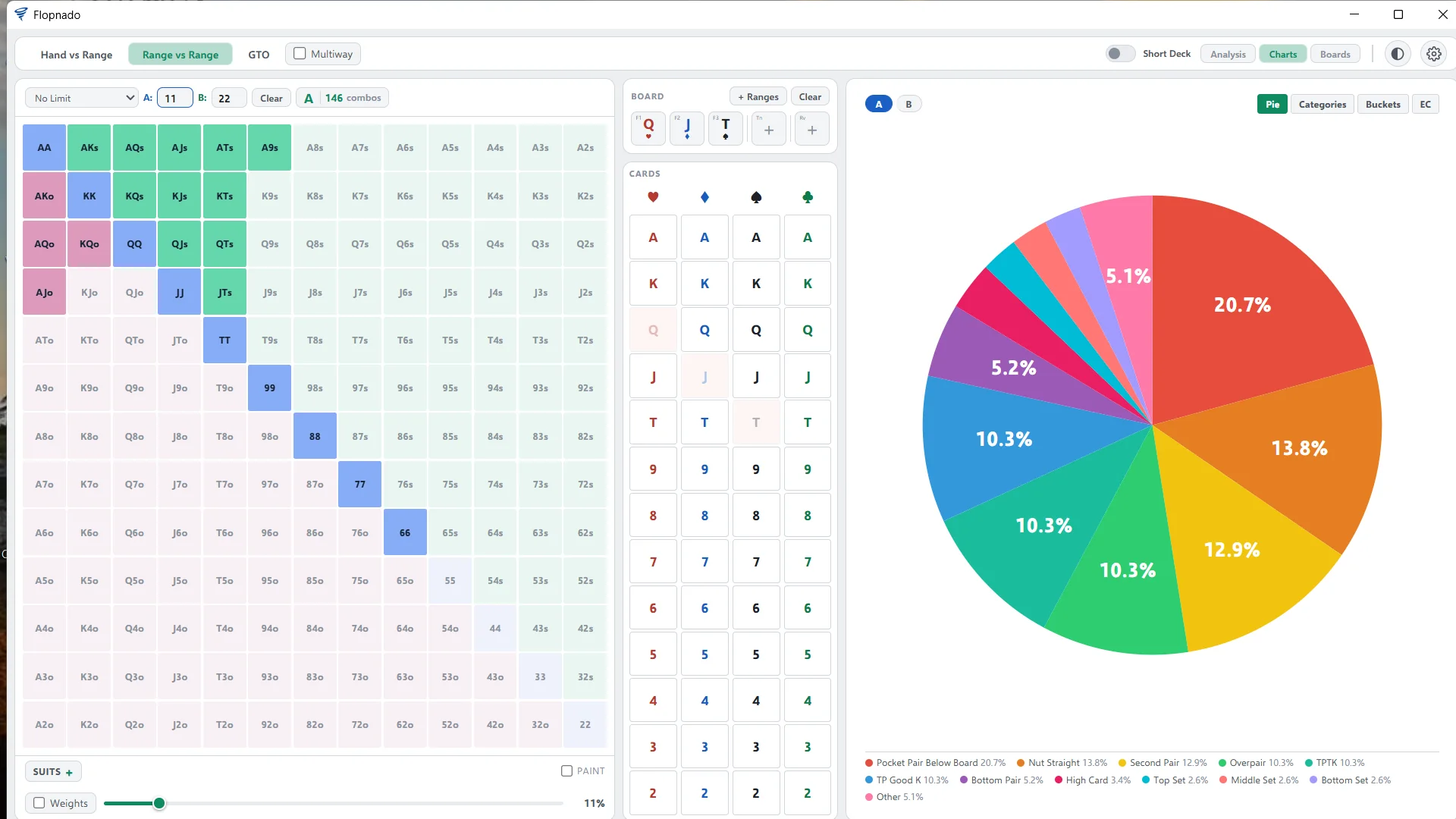
What a range is made of.

The pie splits a range into hand types. On Q♥J♦T♠7♦, Range A is 15.9% pocket pairs below the board, 14.2% nut straights, 13.3% second pair, and so on.

Charts · 2 of 4locks during play

Both ranges side by side.

Categories puts both ranges next to each other, for made hands or for draws. Range A is 66.3% pairs, Range B 59.3%.

Charts · 3 of 4locks during play

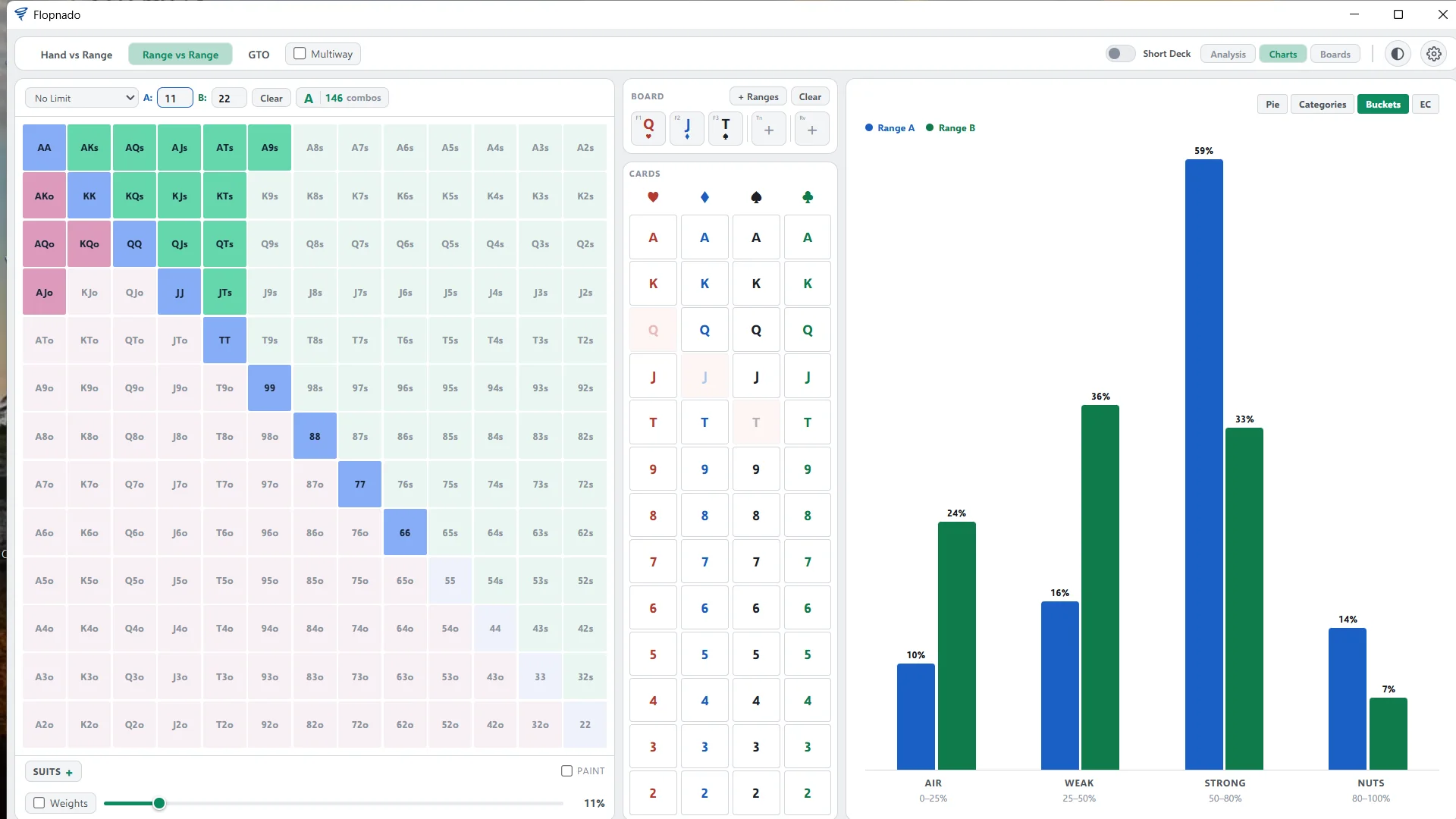
Air, weak, strong, nuts.

Buckets sorts every hand by its equity: air under 25%, weak 25 to 50%, strong 50 to 80%, nuts over 80%. 60% of Range A is strong, against 36% of Range B.

Charts · 4 of 4locks during play

Every hand, strongest to weakest.

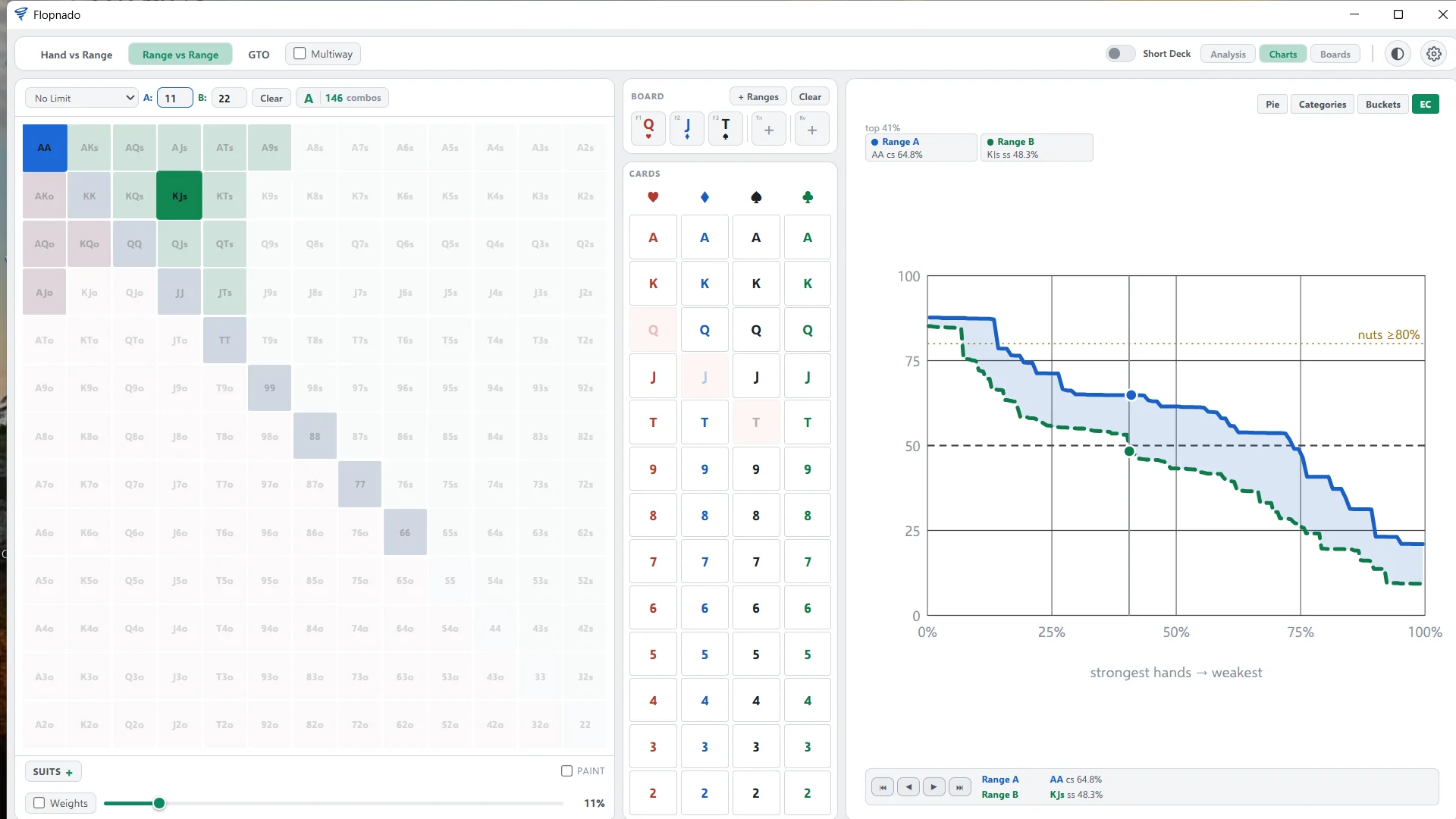
The equity curve plots both ranges hand by hand, with the nuts line at 80%. Hover anywhere to see which hand sits there.

Multiway · 1 of 5locks during play

Up to 9 ranges at once.

Tick Multiway and give every seat its own range. The top row shows each seat's equity, from UTG at 20.4% down to the big blind at 5.9%.

Multiway · 2 of 5locks during play

The same tools, more players.

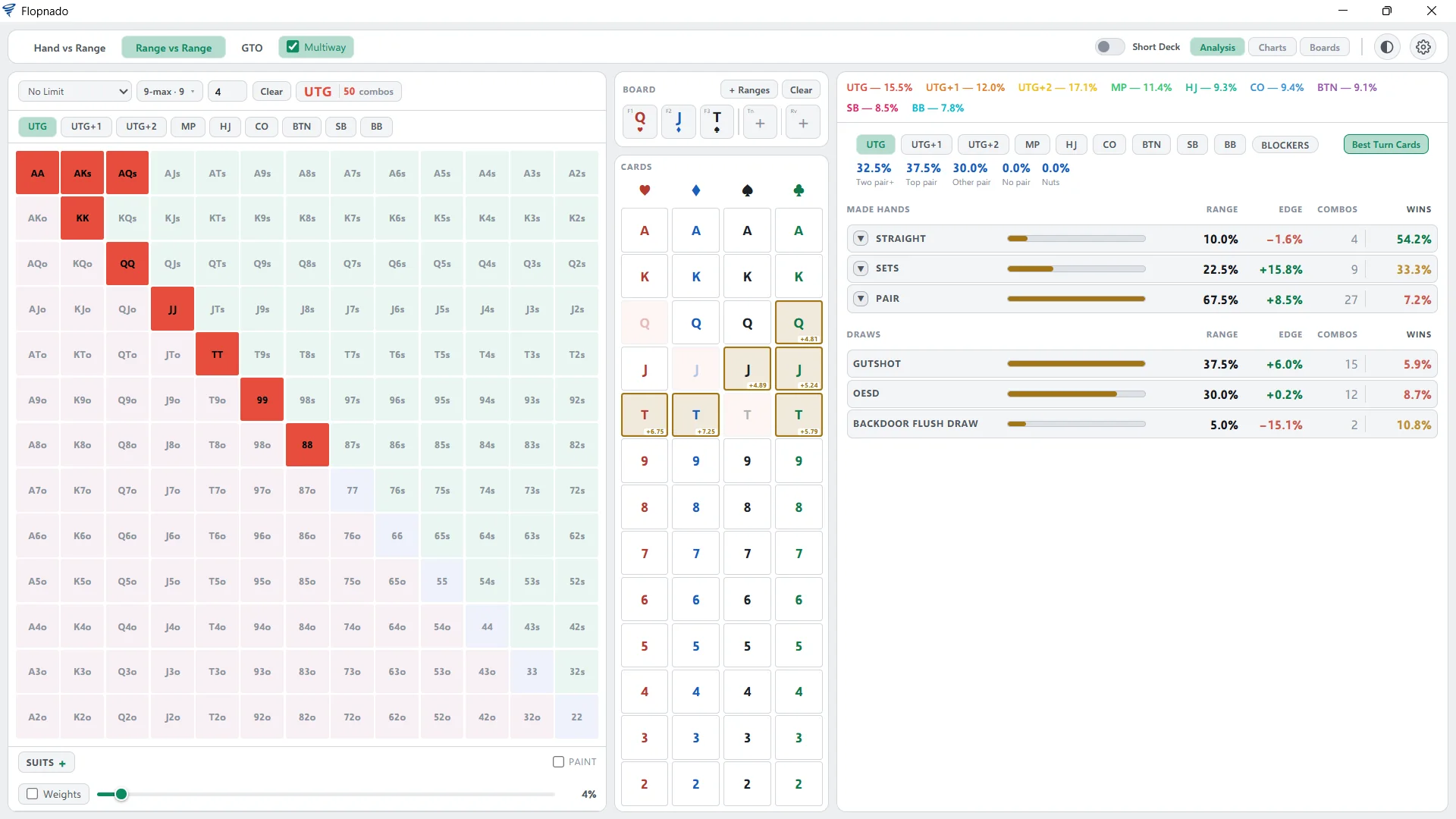
Every tool from Range vs Range works here. Lock UTG's pairs and the grid shows each combo. Best Turn Cards shows the kings add up to 9 points.

Multiway · 3 of 5locks during play

Everyone's equity curve.

Each seat gets its own line. Hover a point and you see the hand at that spot for every seat, like KQo for UTG at 18.3% and AA for the hijack at 16.3%.

Multiway · 4 of 5locks during play

How each seat's range is spread.

Buckets shows air, weak, strong and nuts for all nine seats in one table. The button's wide 77% range is 45% air.

Multiway · 5 of 5locks during play

Change a range, see it update.

Change a seat's range and its row updates. UTG+2 on 33% has 41% strong hands and 4% nuts.

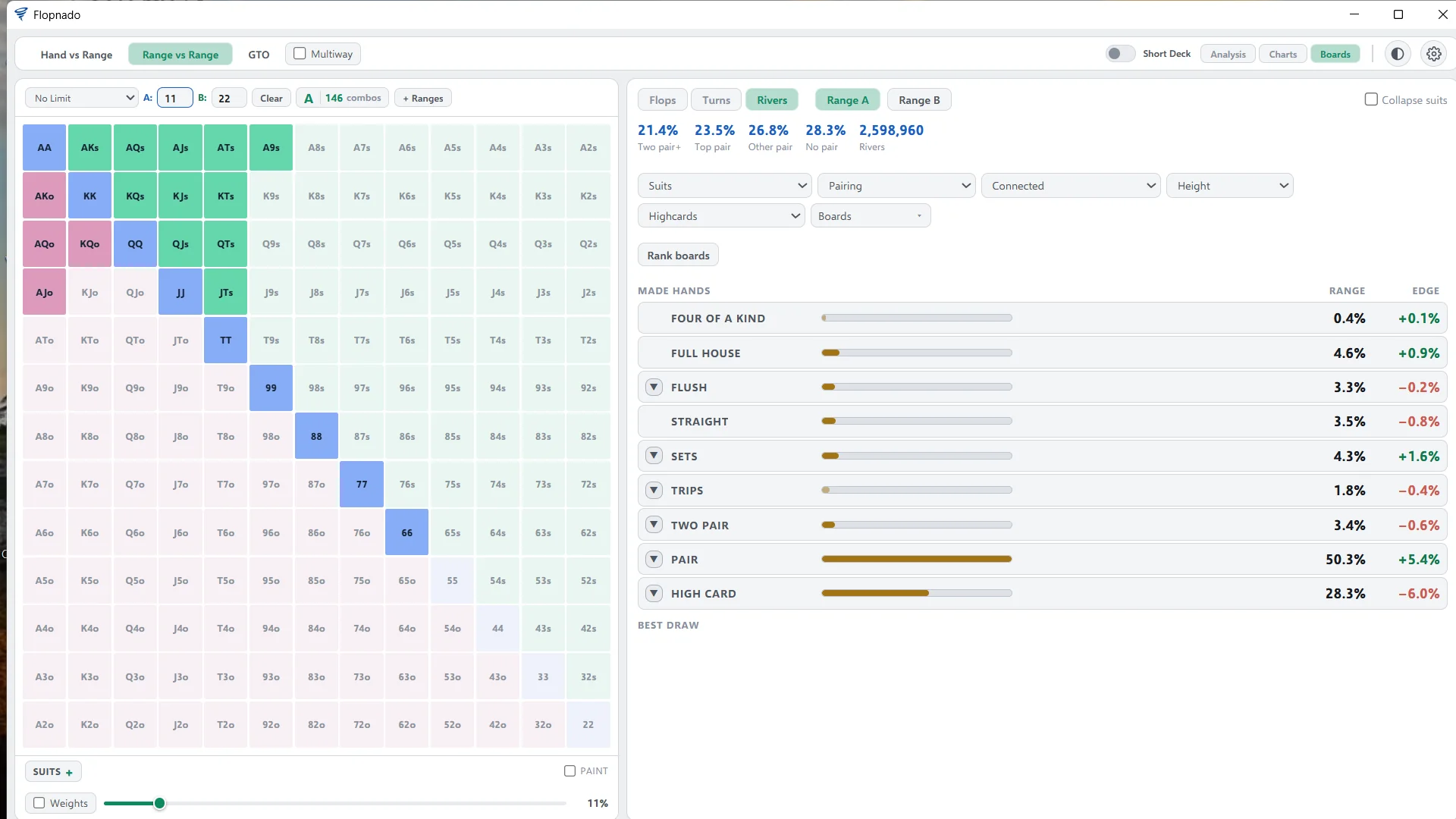
Boards · 1 of 3locks during play

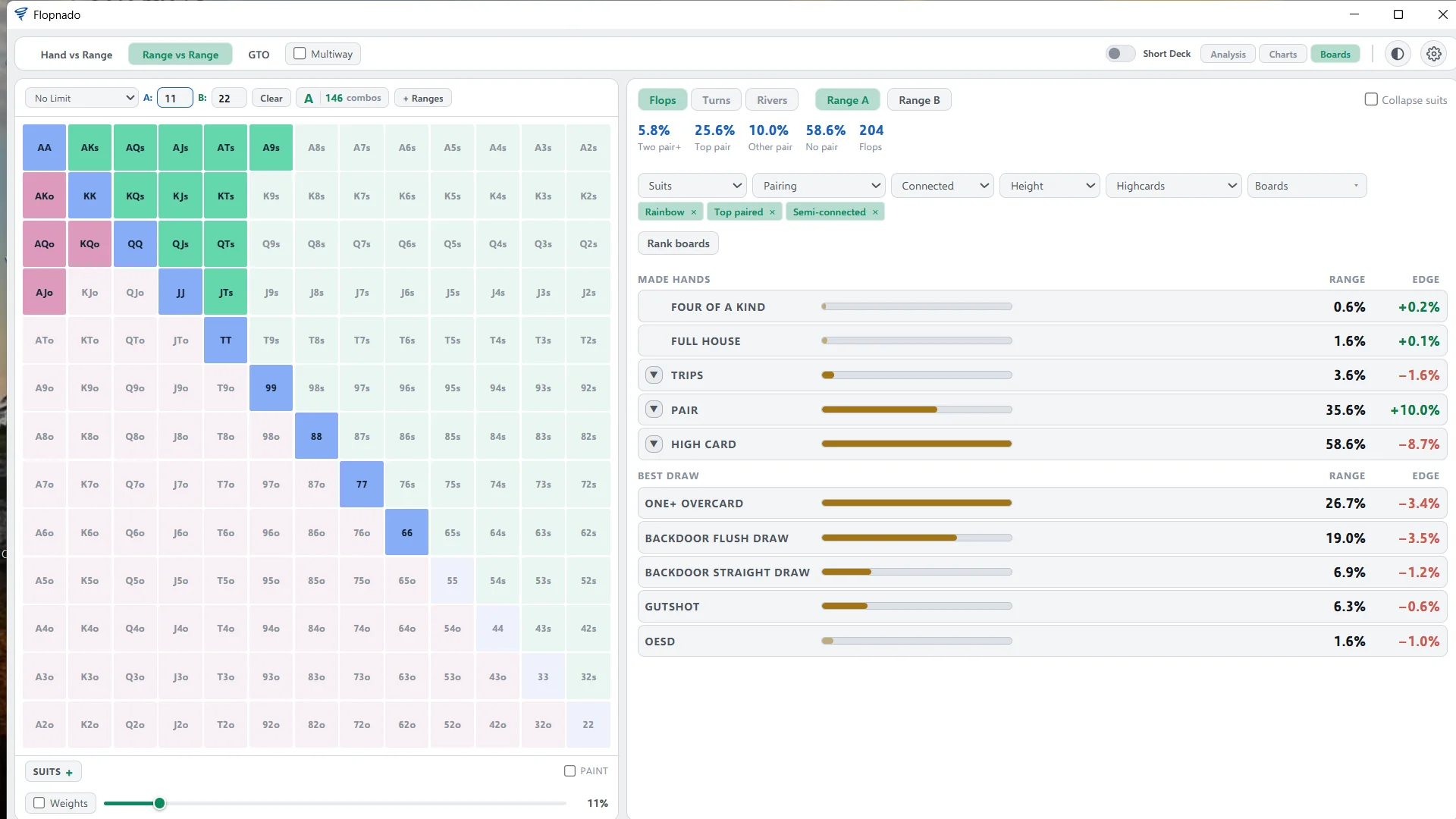
How a range hits every flop.

Boards runs your range over every possible flop, all 22,100 of them. It adds up what the range makes, from four of a kind down to high card, plus the best draws. Flopzilla and Equilab on a Mac? See every alternative →

Boards · 2 of 3locks during play

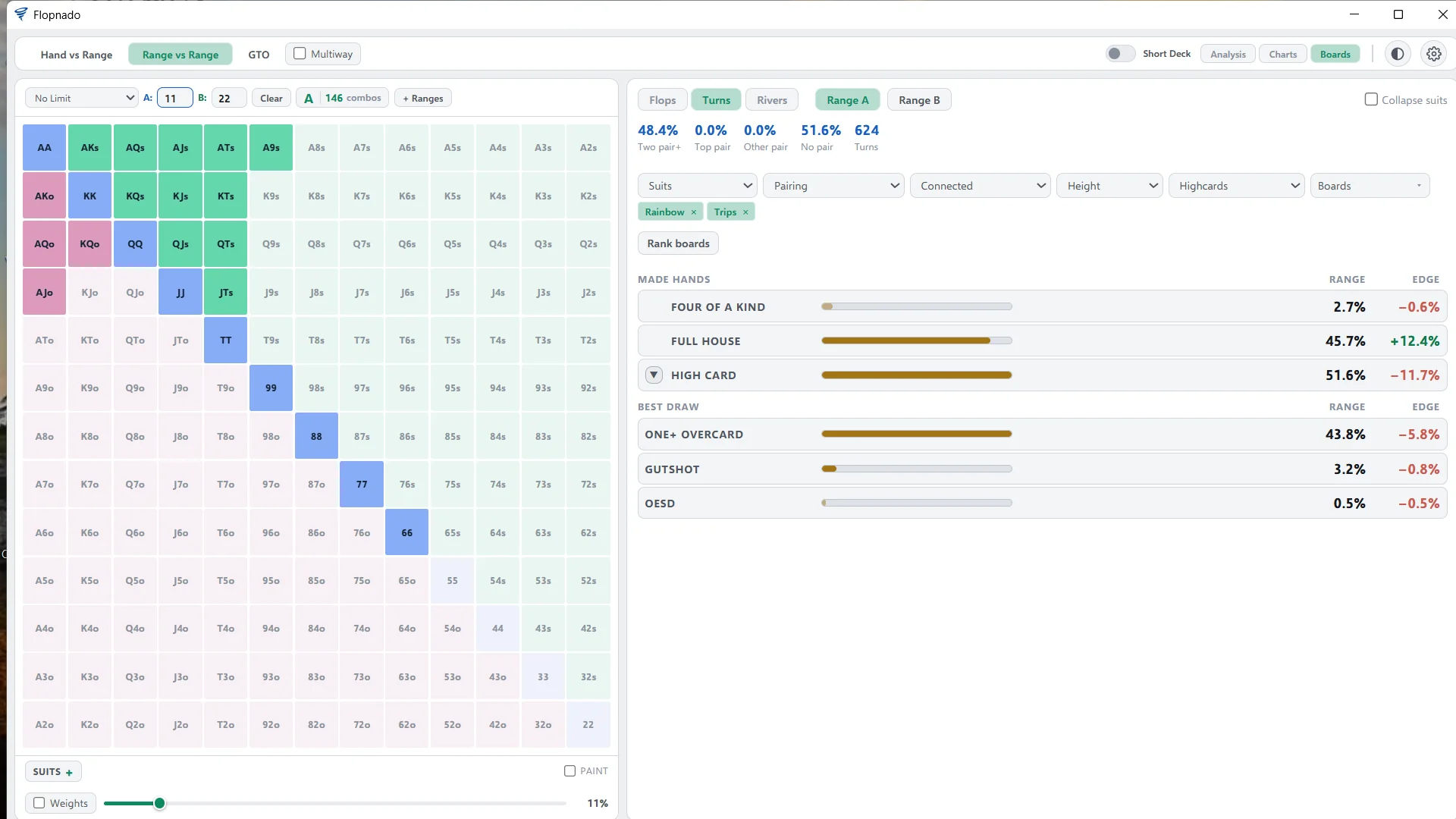
Filter by texture.

Narrow it down by suits, pairing, how connected, height and high cards. Here it is rainbow, unpaired, semi-connected, ace-high turns: 1,440 of them.

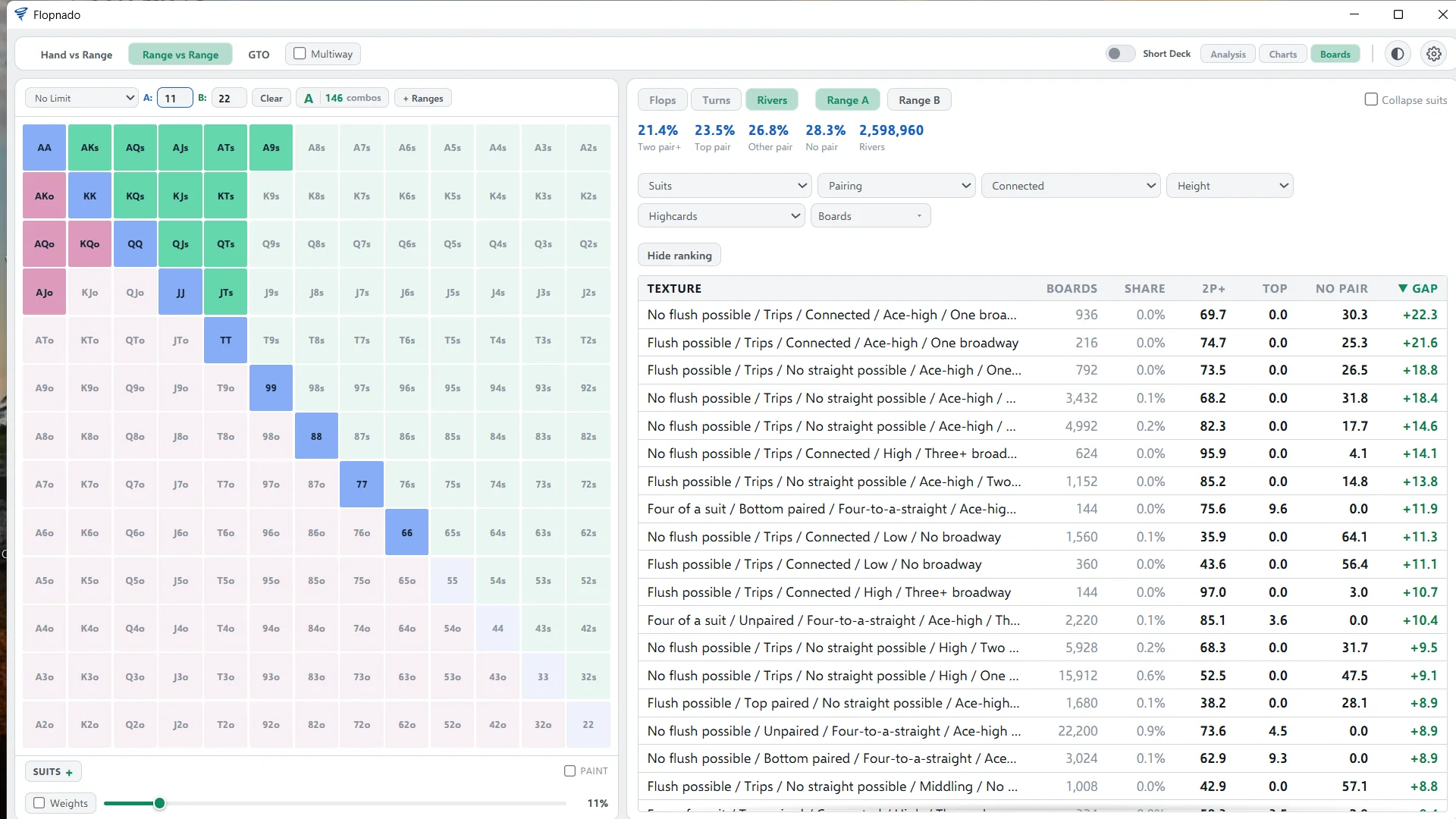
Boards · 3 of 3locks during play

Rank the boards.

Rank boards lists every texture with how often the range makes two pair or better, top pair or no pair, and the gap against the other range. Sort by any column.

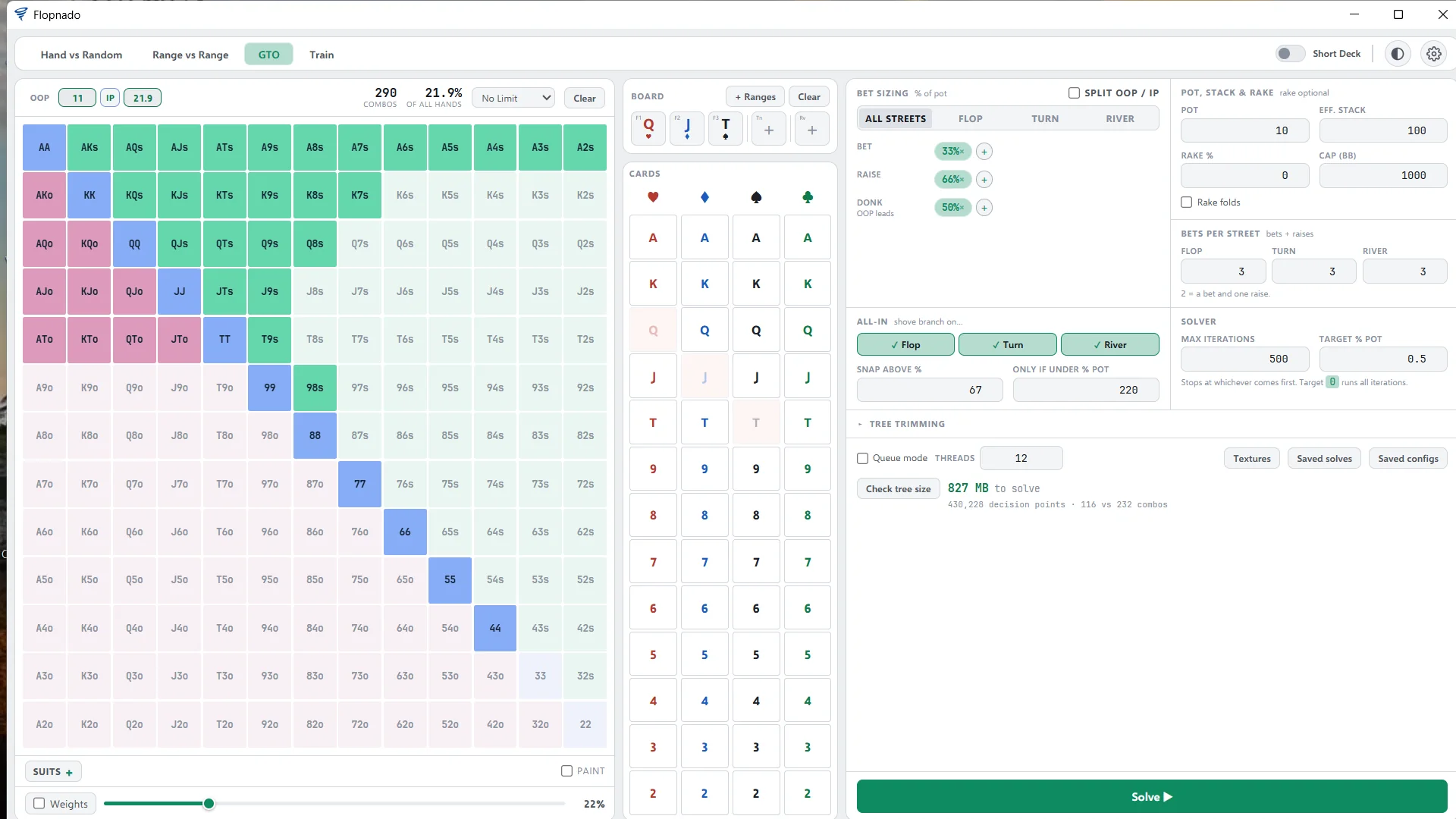
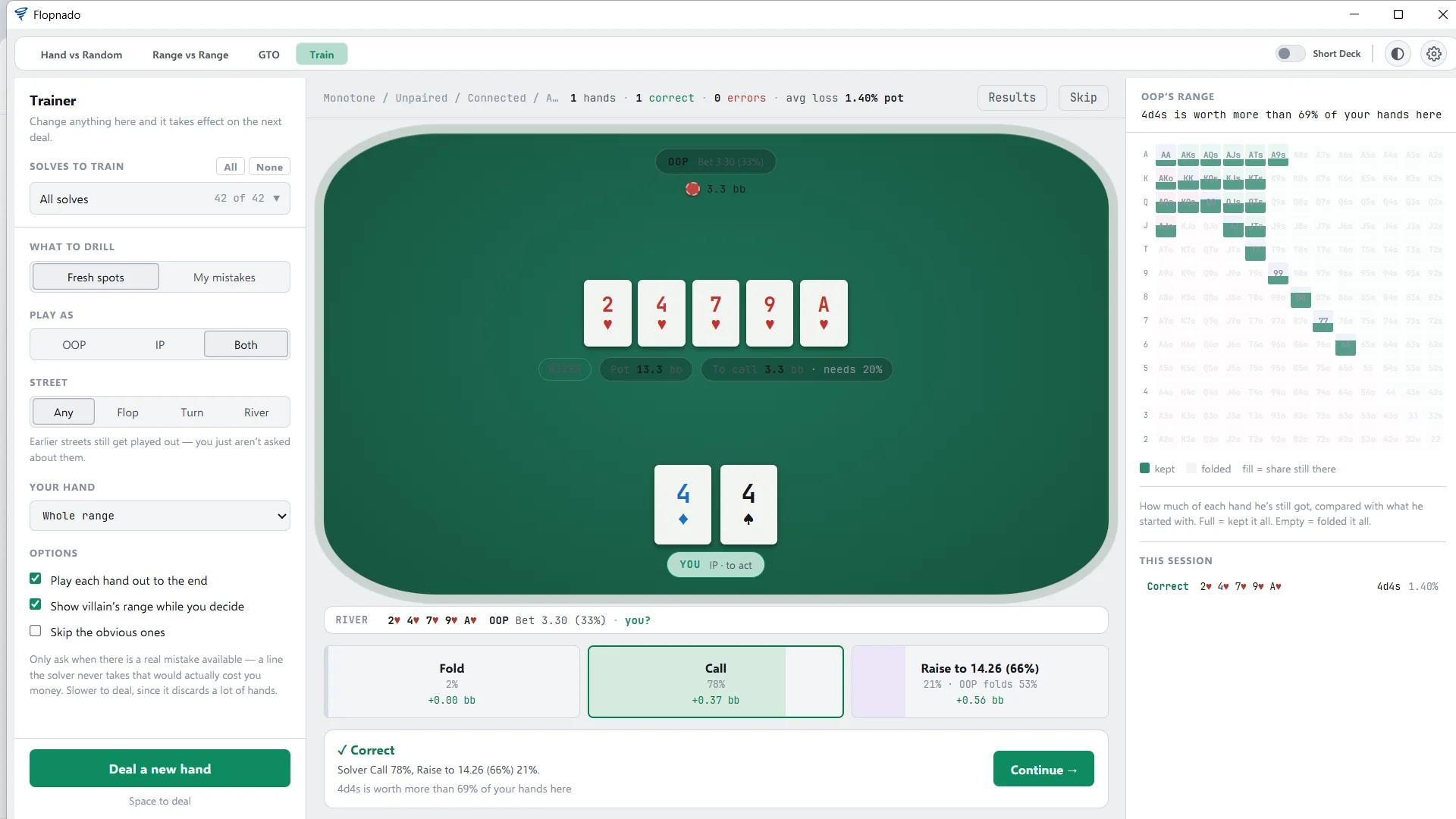
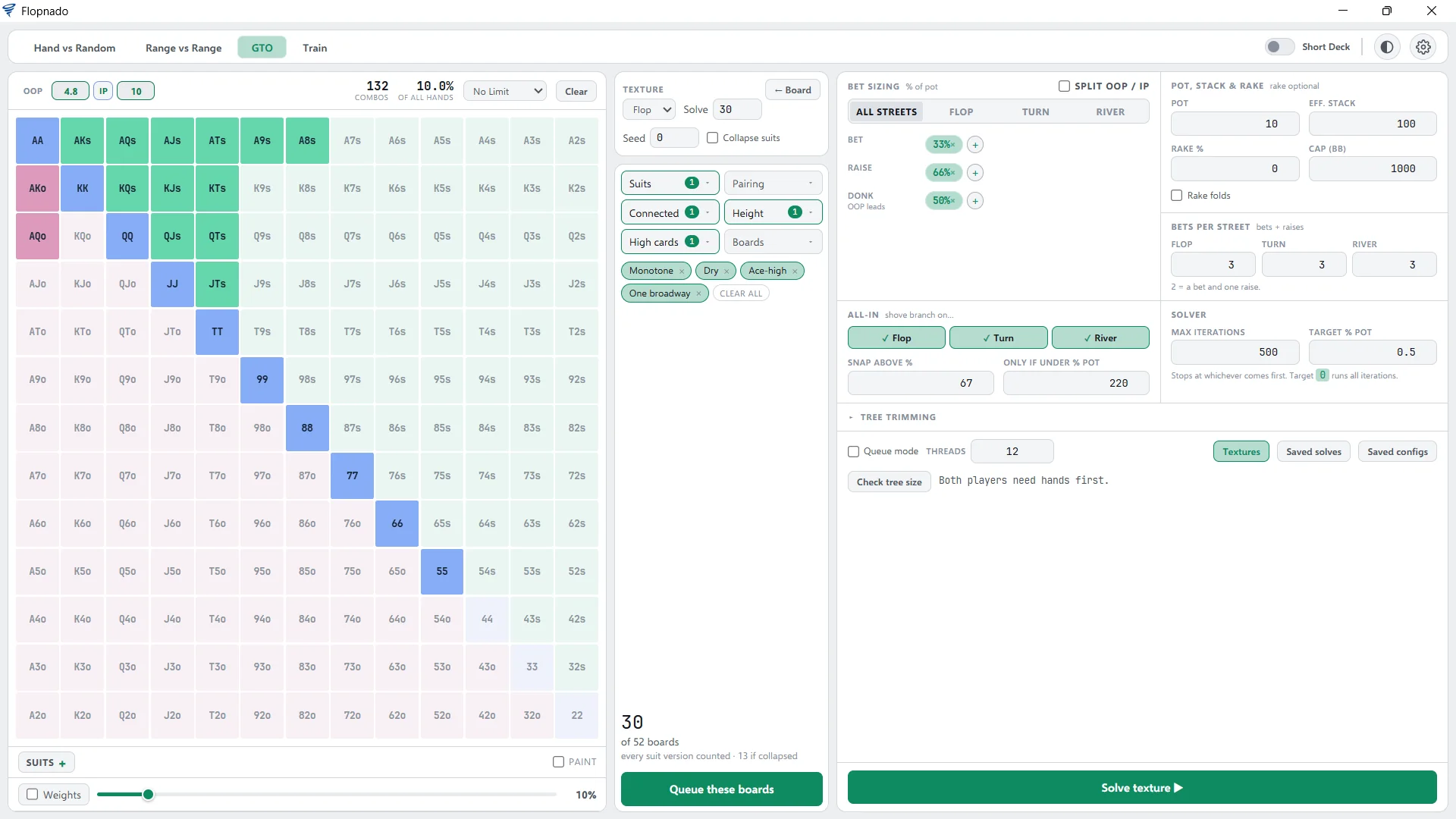
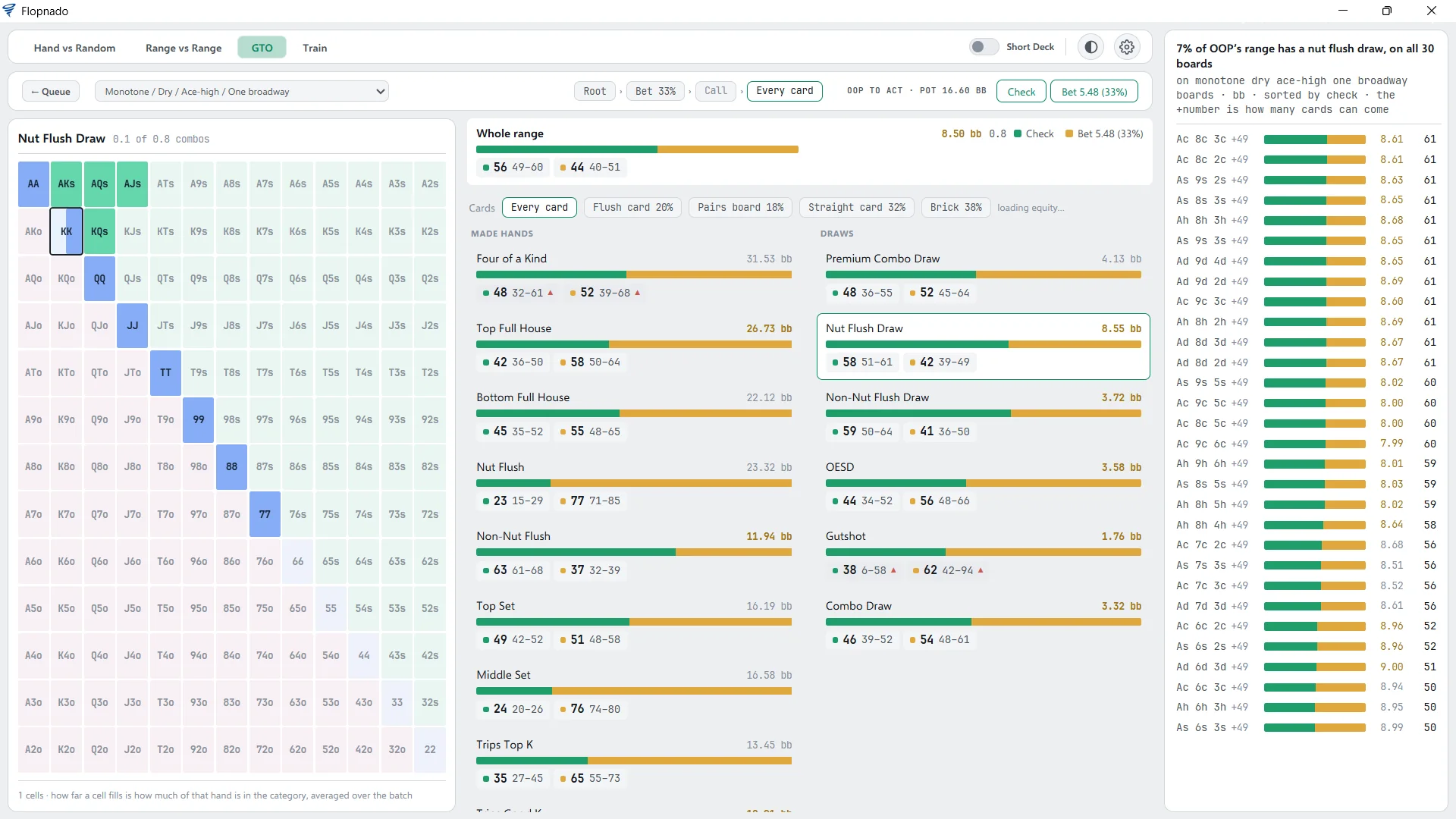
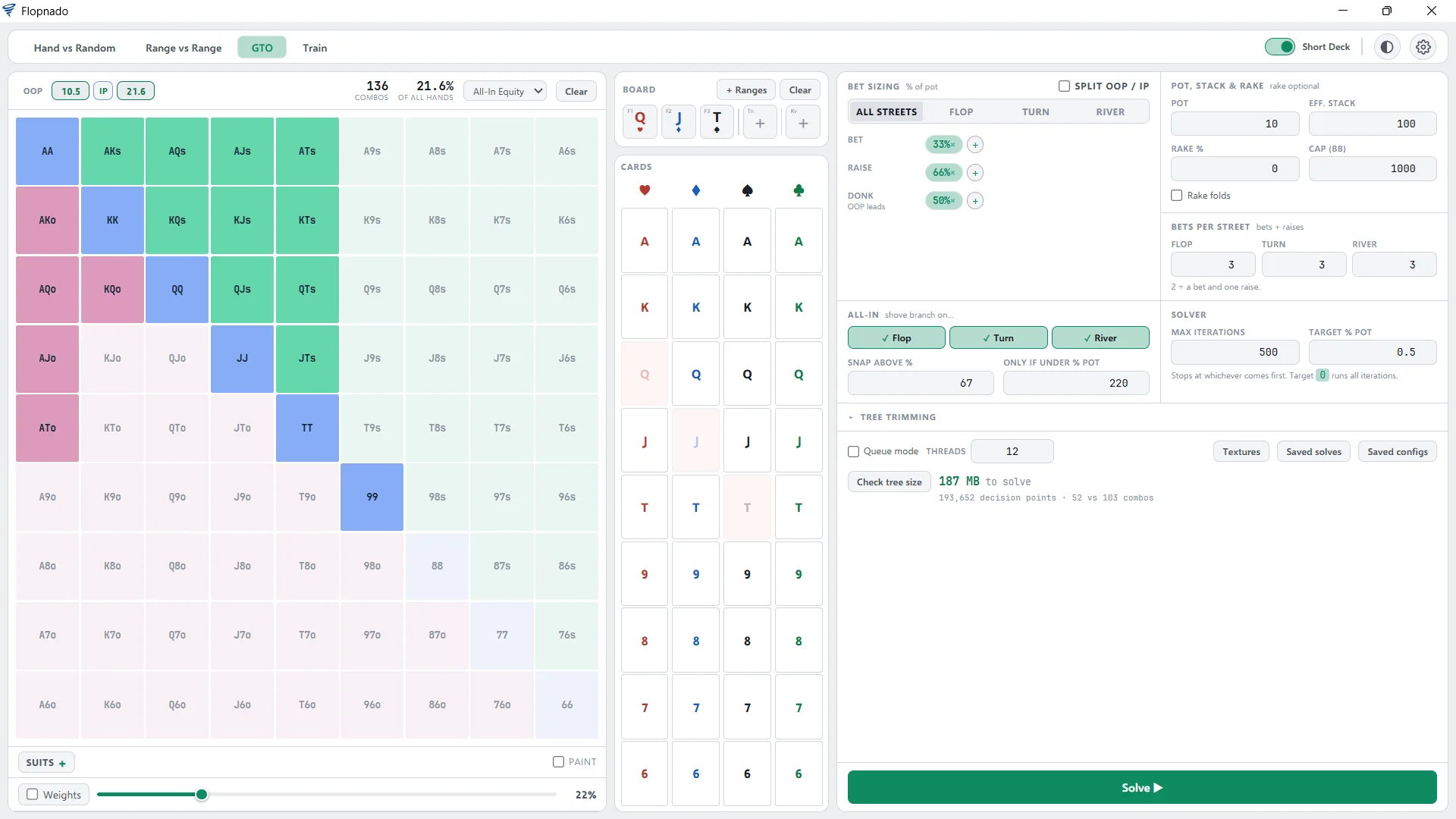
GTO Solver · 1 of 7locks during play

Set up the spot.

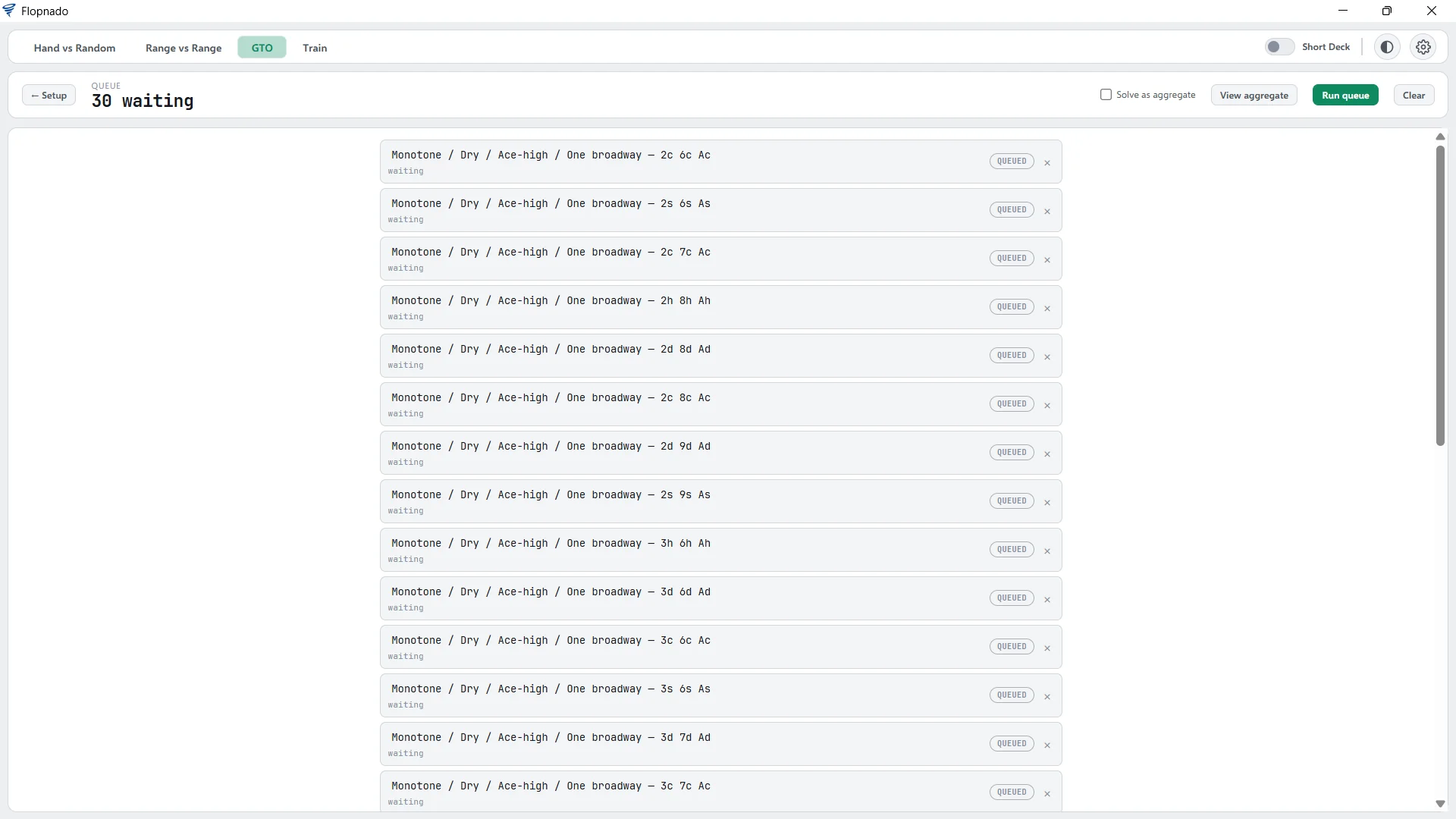
Pot, stacks and rake. Bet, raise and donk sizes for every street or each one on its own, split by player if you want. Caps on bets per street, when all-ins happen, and how accurate to solve. Check tree size tells you the memory a solve needs before you start, 827 MB here. Queue spots, or solve a whole texture.

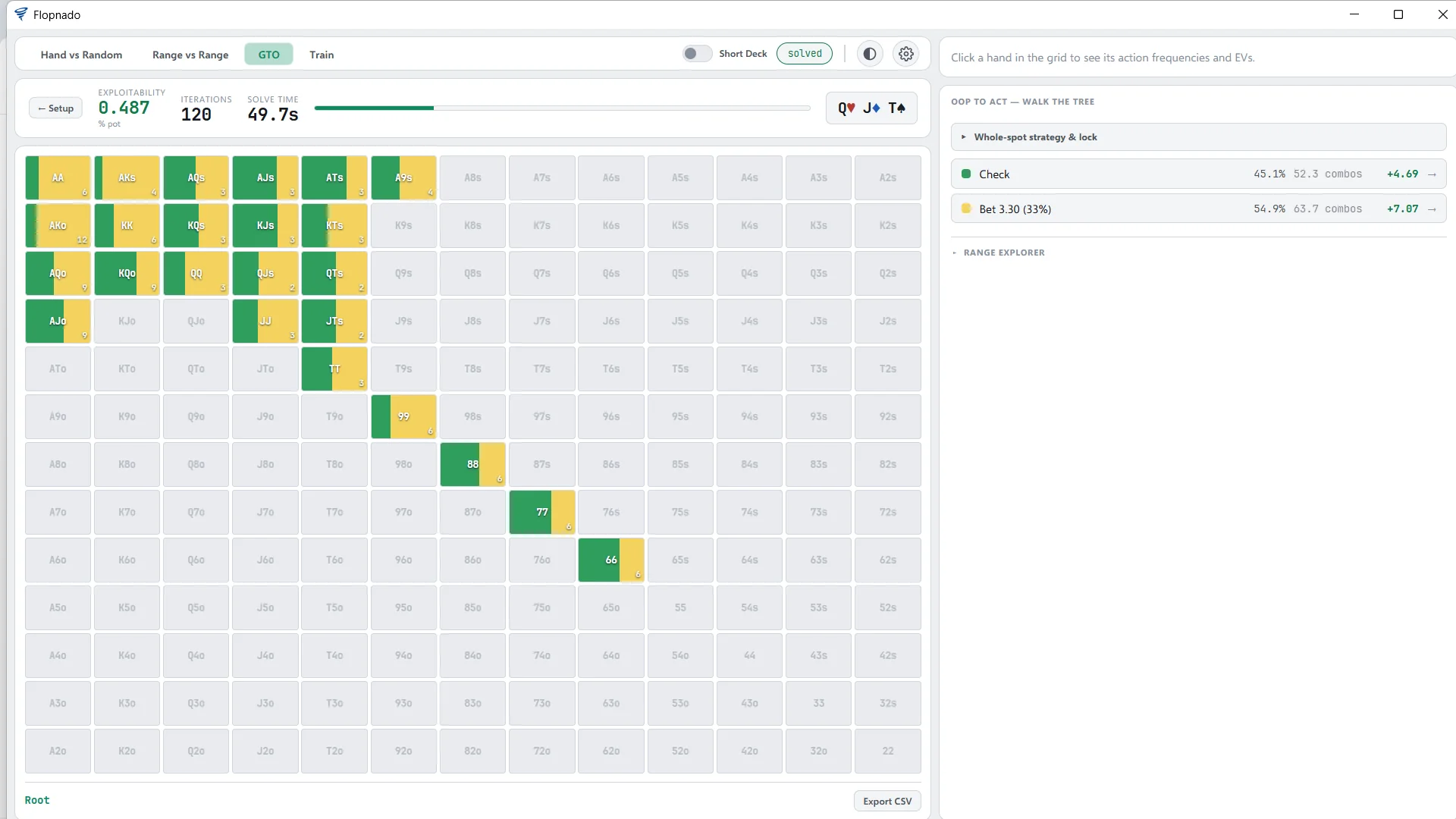
GTO Solver · 2 of 7locks during play

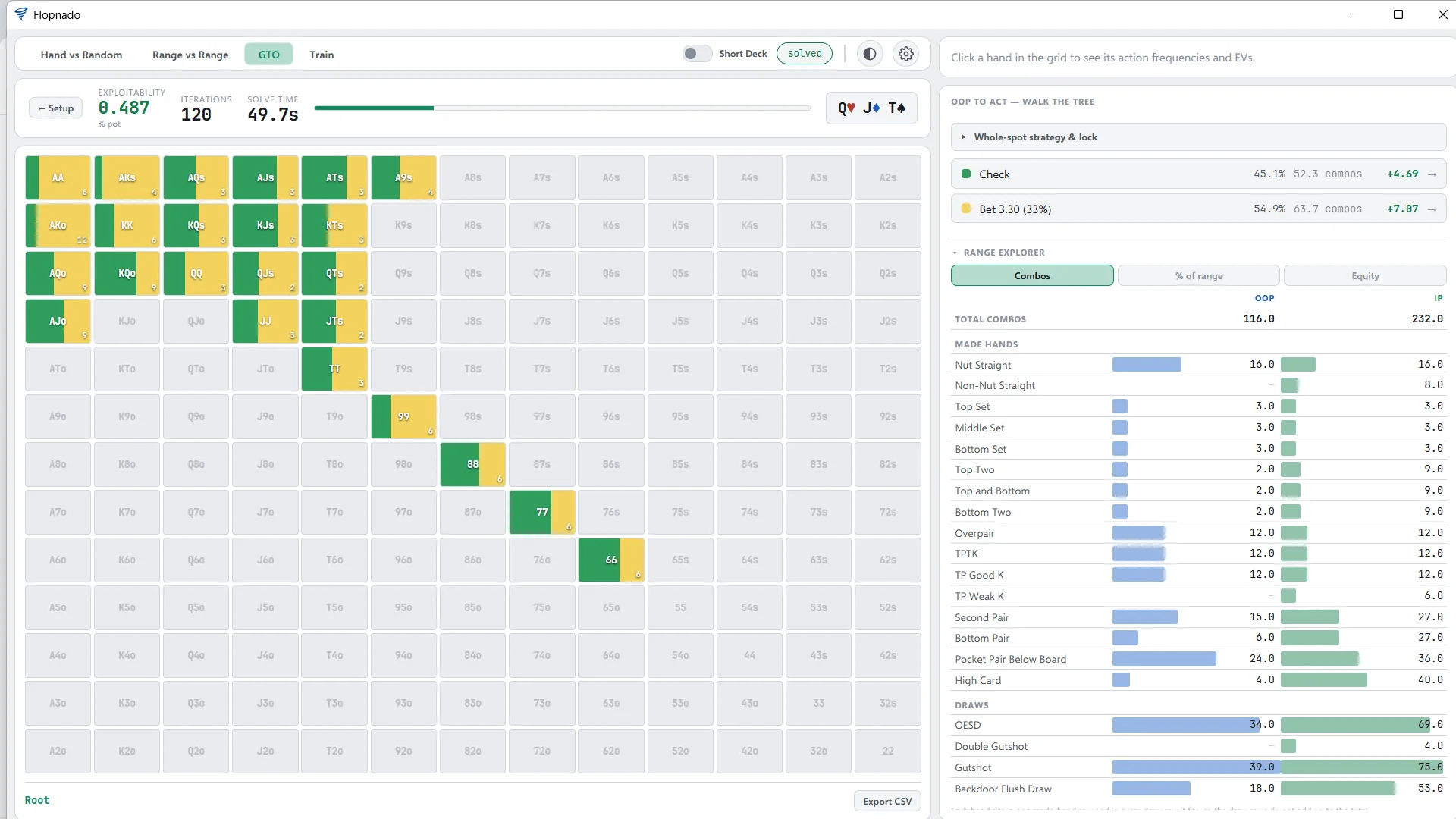
The solved strategy.

This one solved to 0.488% of the pot in 120 iterations and 48 seconds. Every hand in the grid shows its mix. The first player checks 45.1% and bets a third of the pot 54.9%, with the EV of each. Tested against PioSolver: same strategy, half the memory →

GTO Solver · 3 of 7locks during play

Compare both ranges.

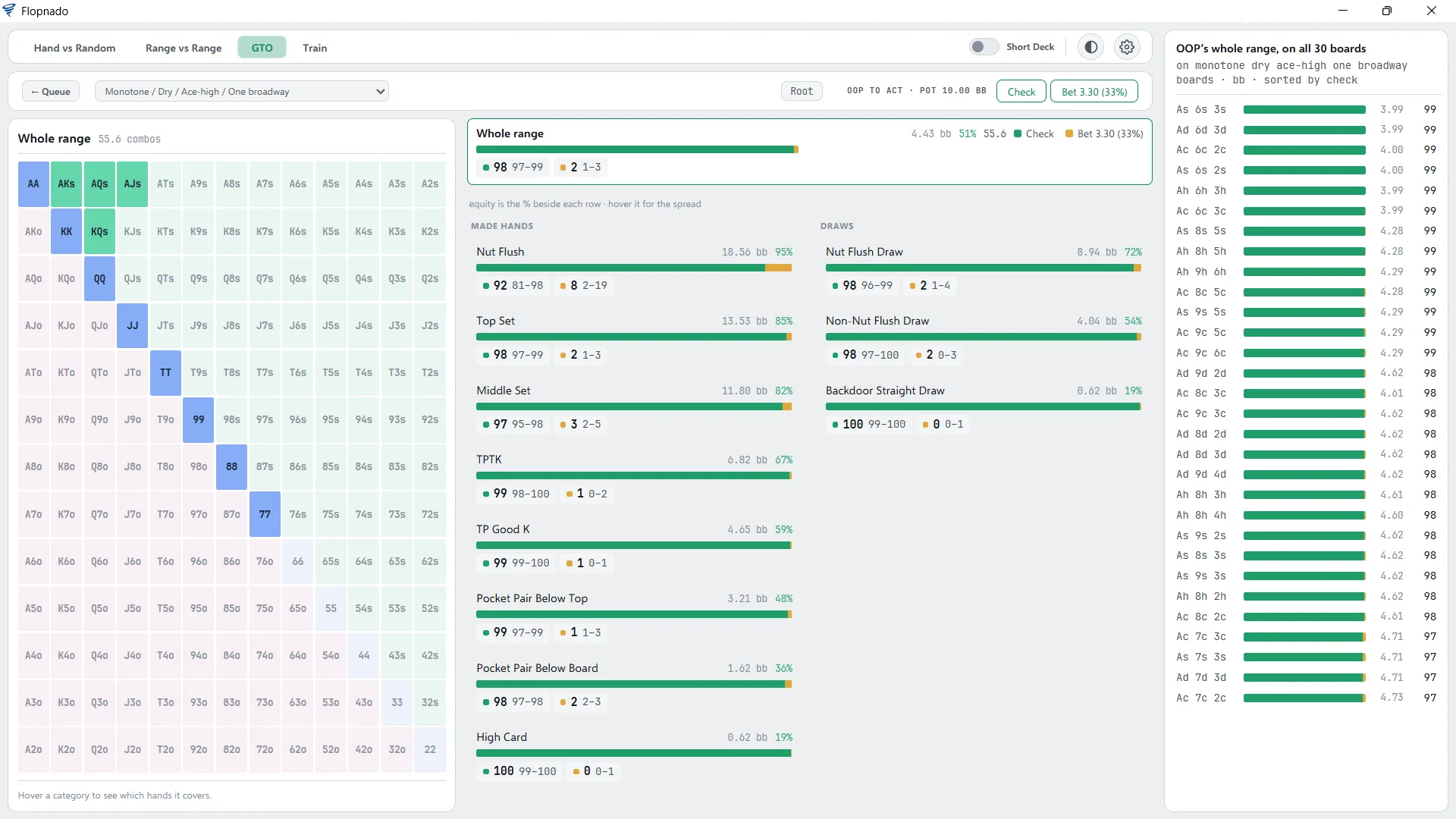
The range explorer breaks each range down by hand class: nut straights, sets, two pair, top pair by kicker, draws and more. Show it in combos, % of range or equity.

GTO Solver · 4 of 7locks during play

Change how one hand plays.

Click a hand, like ATs, and drag the sliders to set its mix. Lock hand and re-solve to see how the other player adjusts.

GTO Solver · 5 of 7locks during play

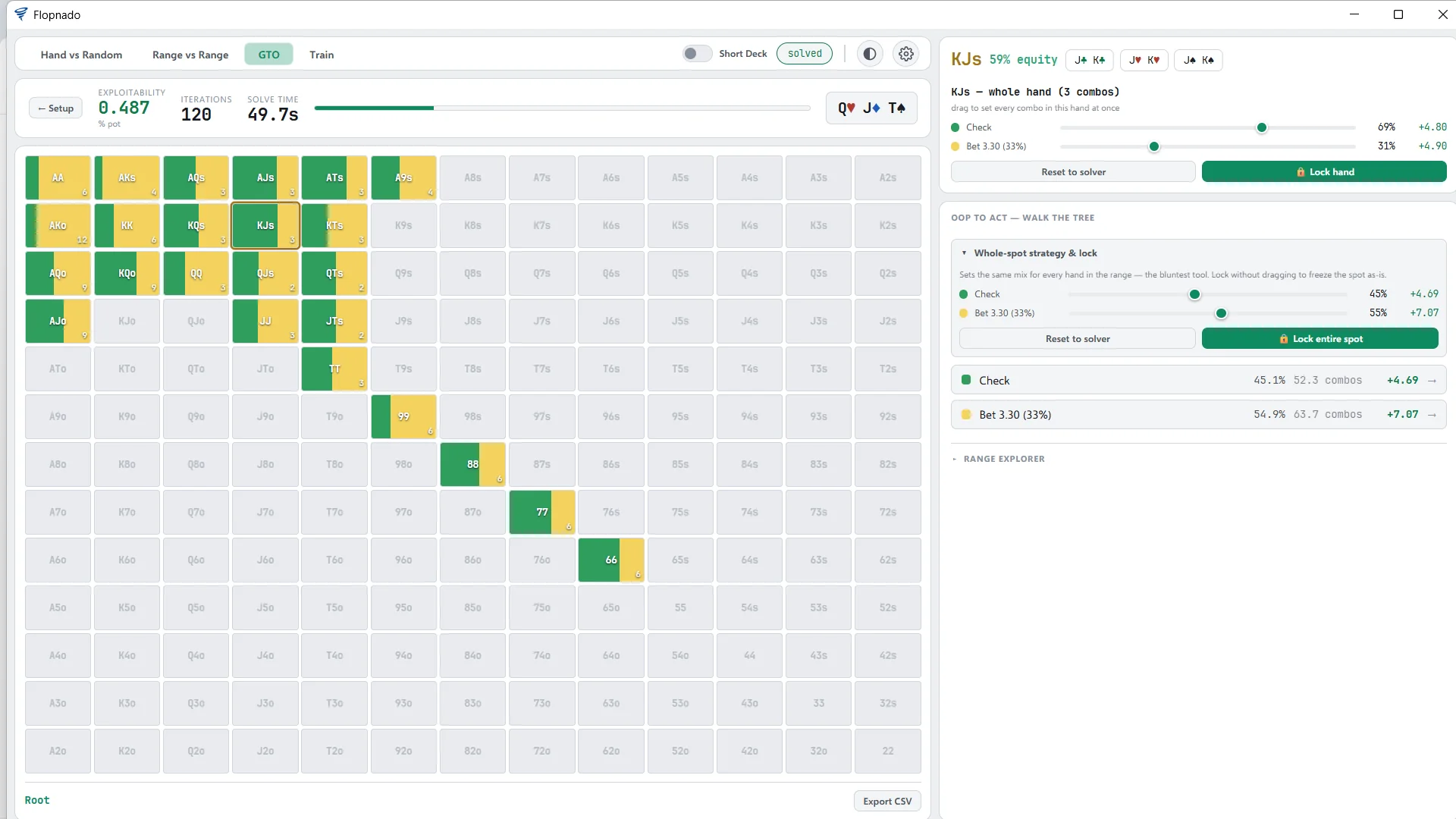
Or lock the whole spot.

Whole-spot strategy & lock sets the same mix for every hand in the range at once. Lock without dragging to freeze the spot as it is.

GTO Solver · 6 of 7locks during play

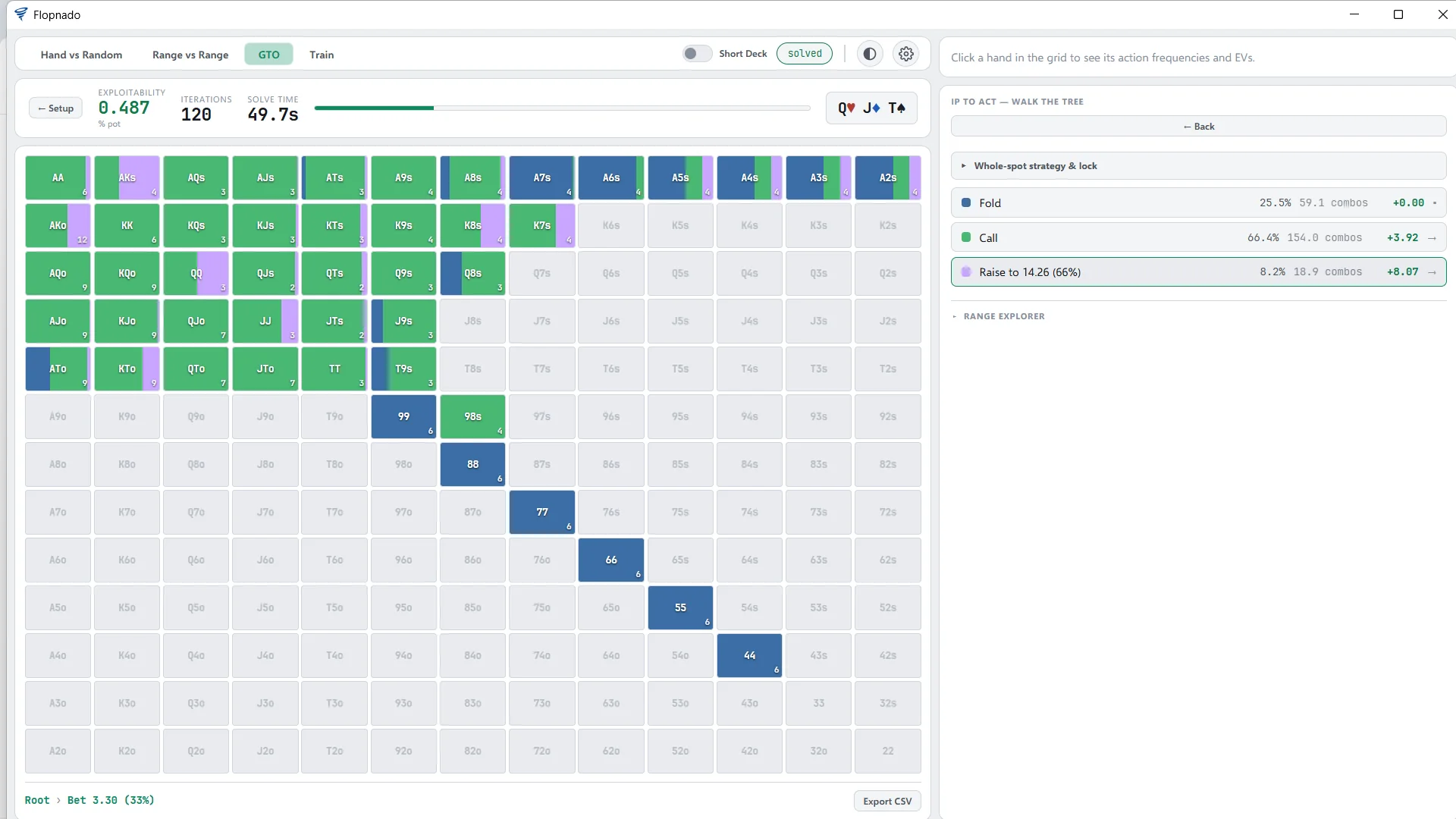
Walk the tree.

Click an action to move down the tree. After a check and a third-pot bet, the first player folds 22.4%, calls 72.6% and raises 5.1%. The path shows at the bottom.

GTO Solver · 7 of 7locks during play

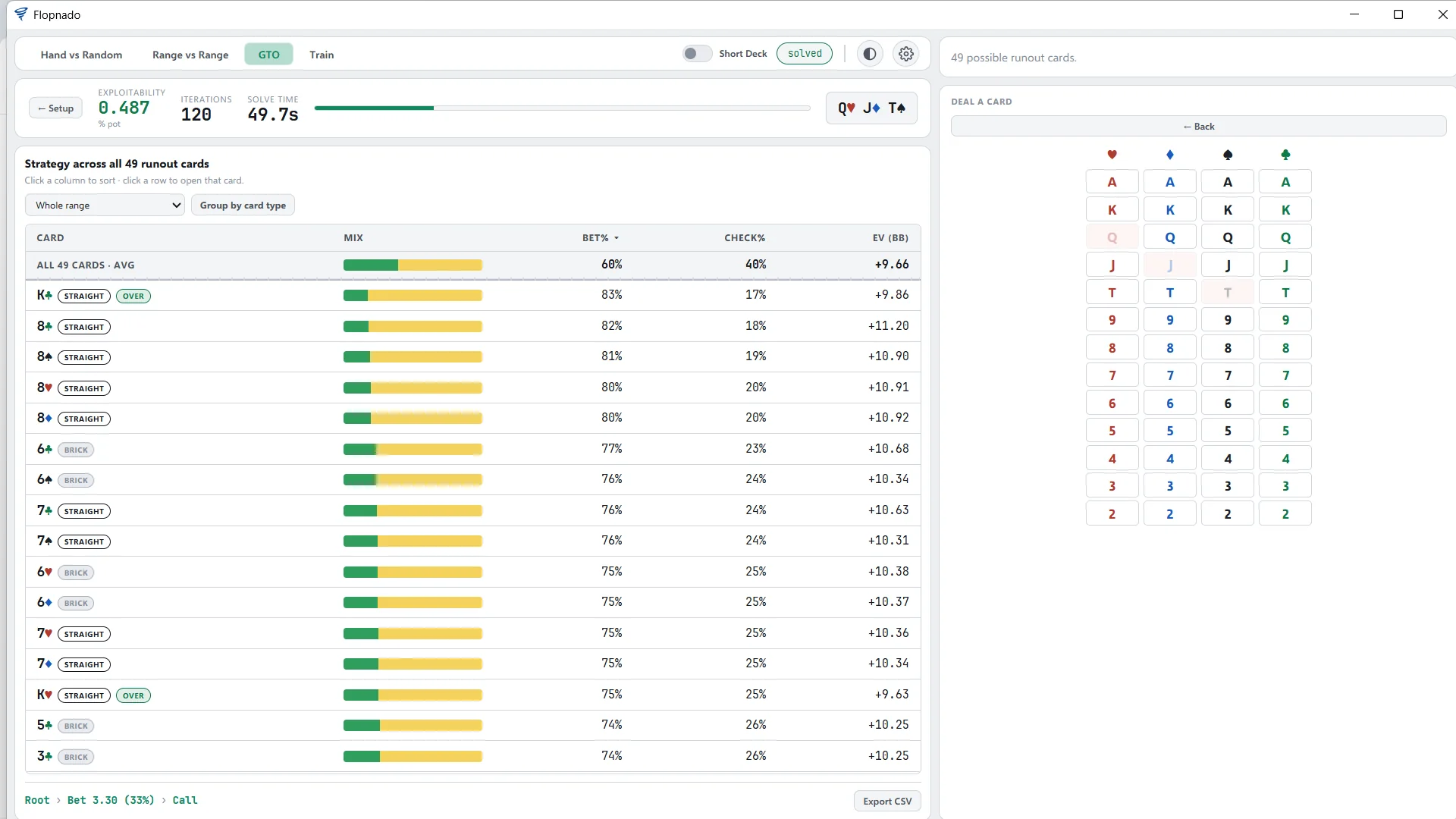
Every turn card at once.

After the call, see the strategy on all 49 turn cards: bet and check frequency and EV for each, tagged straight, over or pairs. Sort any column, group by card type, and click a card to open it.

1 / 26

All the calculators and the solver lock automatically when a real-money table opens. Why it works this way ↓

Site rules

Play by the rules.

Flopnado was submitted to PokerStars and reviewed against their third-party tools policy. Two design decisions make that possible:

Completed hands only

The HUD is built from hand history files written after each hand ends. It never reads live card data and never suggests an action. It's a tracker, in the same category the sites already permit.

Study tools will not open during live play

The moment a table opens, all the calculators and the GTO Solver are locked, and stay locked until you close the poker client window. Only the HUD runs while you play.

Platforms

Works where you play.

Flopnado reads hand history files from 9 sites. 6-max and 9-max No-Limit Hold'em, cash games and tournaments.

PokerStars
888poker
Red Star Poker
ACR Poker
Paddy Power Poker
KingPoker
bet365 Poker
Betsson
Winamax

On a Mac? Some poker sites don't have a Mac version. Check your site works on Mac before you buy.

Flopnado is independent and not affiliated with, or endorsed by, any of these sites. Names and logos belong to their owners.

Pricing

Pay once. That's it.

No monthly fee. No subscription.

Every download starts with a 48-hour trial of everything. When the trial ends, the HUD and analytics keep working for free. By position and Vs Hero stats switch off, along with the calculators and the GTO solver. Buy once to keep everything.

Free

€0

After your trial. No card, no time limit.

  • HUD with all 36 stats, up to 4 tables
  • Full stats popup with the street filter
  • All customisation: colours, styles, layouts
  • Analytics and hand replayer
  • All 9 sites
  • By position and Vs Hero (reverse HUD)
  • Calculators and GTO solver
Start with the trial

Start your 48-hour trial

Enter your email and the key arrives straight away. Everything unlocked for 48-hour, then the HUD stays free. One trial per person and per computer.

By requesting a key you agree to the Terms. We use your email to send your key. See the Privacy Policy.

Download Flopnado

Windows Windows 10/11 · 64-bit Mac: Apple chip M1, M2, M3, M4 and newer Mac: Intel Older Macs with an Intel processor

Which Mac do I have? Click the Apple menu, then About This Mac. If it says Chip, pick Apple chip. If it says Processor, pick Intel.